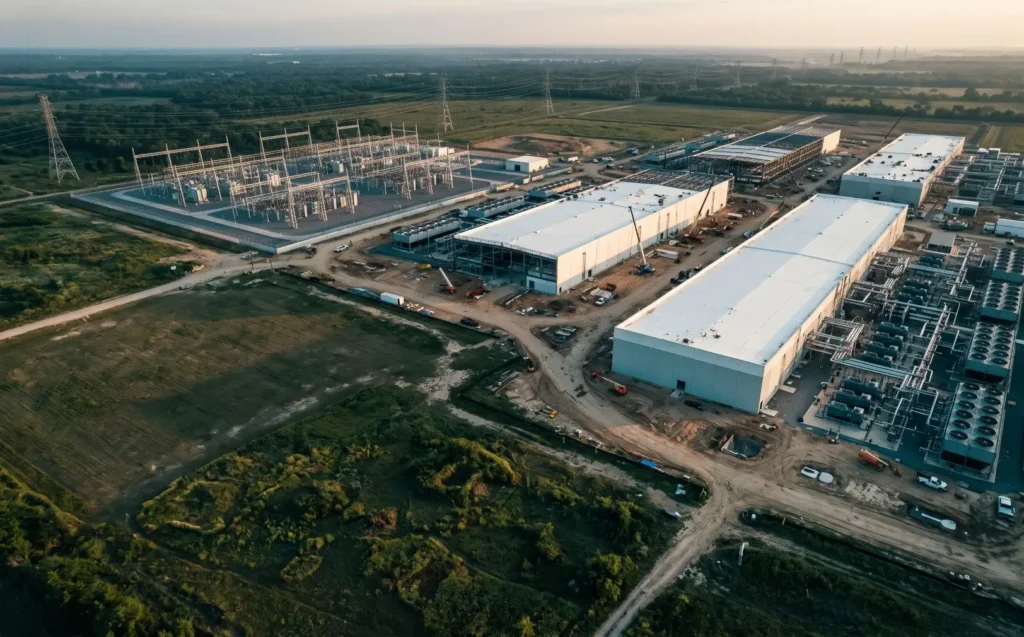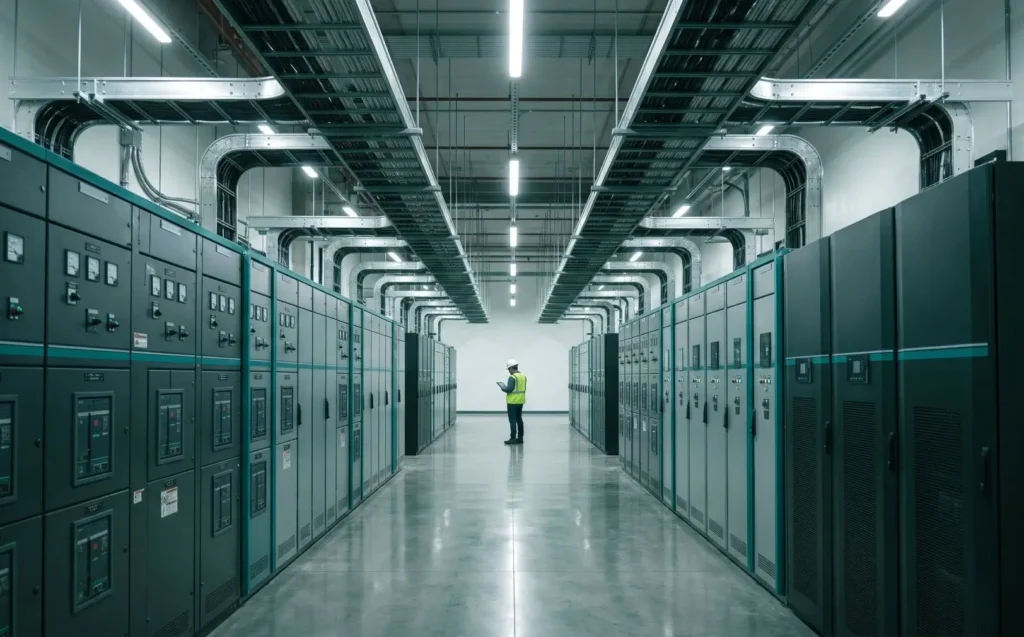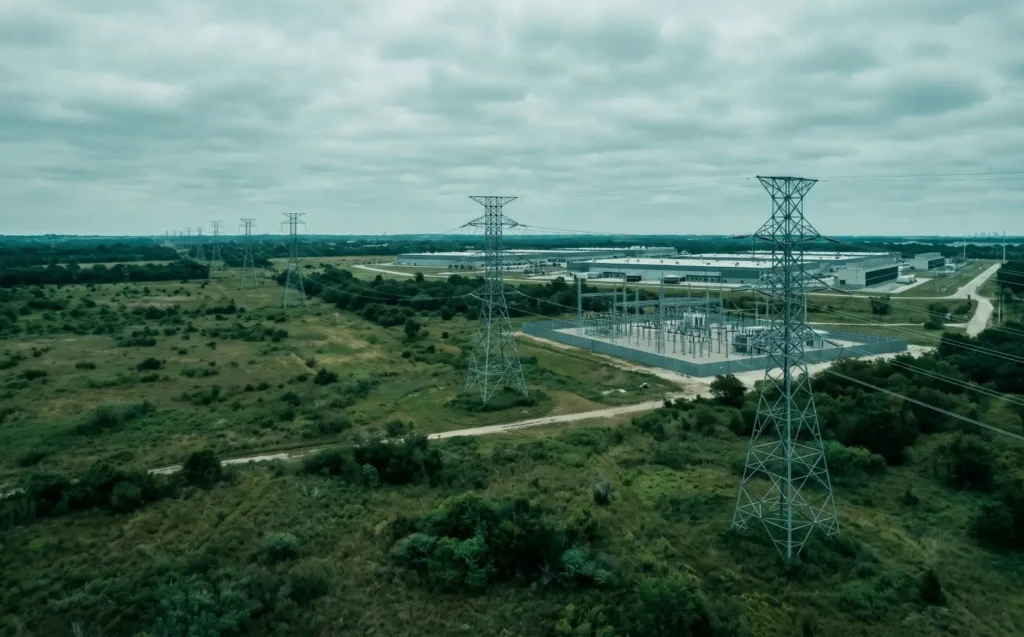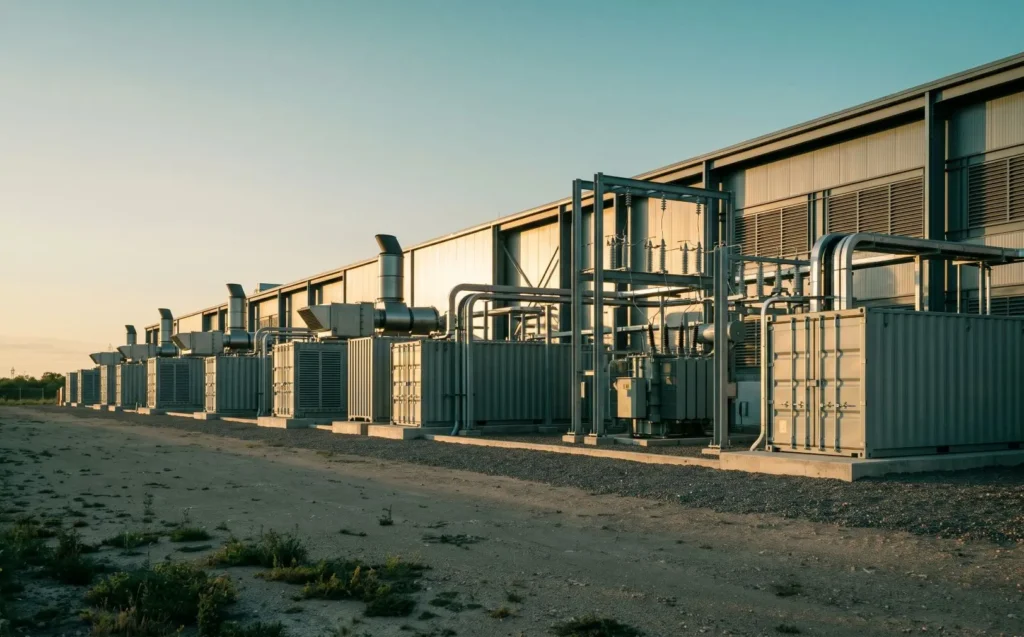
A hyperscale data center developer required 400 MW of electrical capacity, but the local utility could not guarantee supply within the project’s construction schedule. Uncertainty surrounding future electricity tariffs added another consideration to the power procurement decision. PowerTek was engaged to evaluate a behind-the-meter (BTM) generation alternative combining natural gas turbines and battery energy storage. The assignment covered technical feasibility, generation technology selection, preliminary electrical engineering and a comparative economic assessment of utility-supplied power and dedicated on-site generation.
Project Context and Investment Requirements
The developer faced two related questions: whether it could obtain sufficient electricity to support the planned data center opening, and which supply arrangement would provide an acceptable long-term cost structure.
The proposed development required an initial 200 MW energization phase, followed by expansion toward 400 MW. The utility interconnection schedule could not provide the certainty required for the first phase, while projected tariff increases created exposure to future operating costs.
PowerTek’s assessment was intended to establish whether a dedicated hybrid power plant could meet the facility’s electrical requirements, how the generation and storage assets should be configured, and whether the investment was economically preferable to relying on utility supply.
Technical Requirements and Operating Constraints
The hybrid plant needed to support a large, continuously operating electrical load while responding to changes in data center demand.
Generation capacity, battery dispatch, transient stability and voltage regulation were central considerations. The proposed system also required coordinated operation across two electrical configurations: connected to the utility network and operating independently during an external grid outage.
Each configuration presented different fault-current and protection requirements. The engineering design also needed to address load rejection, frequency control, reactive power requirements and synchronization with the utility.
These requirements had to be evaluated alongside equipment costs, fuel consumption, maintenance obligations, utility import and export restrictions, and construction sequencing.
PowerTek’s Engineering Approach
Generation Technology Selection and Hybrid Dispatch
PowerTek evaluated multiple generation and storage configurations before selecting an arrangement based on aeroderivative natural gas turbines paired with a 150 MW battery energy storage system (BESS).
The gas turbines were selected to provide the principal generation supply and the operational flexibility required for the facility’s demand profile. Battery storage was incorporated to support peak shaving, frequency regulation and rapid transient load following.
The engineering assessment considered how coordinated turbine and battery dispatch could manage fluctuations in demand while reducing unnecessary fuel consumption and limiting the physical footprint of the generation facility.
The selected configuration formed the basis for preliminary plant design, operating analysis and the project’s economic model.
Microgrid Stability, Islanding and Protection Engineering
PowerTek conducted load rejection and transient stability studies to evaluate the hybrid plant’s response to operating disturbances and transitions between grid-connected and islanded operation.
The work included automatic voltage regulator (AVR) and power system stabilizer (PSS) tuning to address generator dynamic performance, voltage regulation and system stability.
A principal component of the preliminary design was the microgrid islanding and synchronization architecture. PowerTek developed control logic intended to maintain continuity of electrical supply during external utility disturbances, enabling the generation facility to transition into independent operation while maintaining the required voltage and frequency parameters.
The team also developed protection coordination arrangements for both operating states. This included assessing changes in fault-current contributions when the utility connection was available versus when the facility operated as an isolated electrical system.
Reactive power compensation and voltage ride-through requirements were addressed as part of the electrical interface design and applicable grid-code considerations.
Utility Interface and Import/Export Management
Although dedicated generation would provide the principal source of electricity, the facility’s electrical design needed to accommodate its connection to the utility network.
PowerTek evaluated the import and export restrictions associated with that connection and developed an interface strategy incorporating export limitations and the treatment of utility imports during construction and subsequent operation.
The design considered the interaction between generation controls, grid synchronization, protection settings and the commercial requirements governing electricity exchanged with the utility.
Techno-Economic Evaluation and Development Phasing
PowerTek developed a comparative financial and operational model covering the utility interconnection alternative and the proposed behind-the-meter hybrid plant.
The assessment incorporated capital expenditure for generation and storage equipment, associated civil and electrical infrastructure, procurement requirements, operating costs, fuel consumption and long-term maintenance.
These inputs supported a behind-the-meter capital and operating cost comparison, including levelized cost of energy and the implications of utility tariff volatility.
PowerTek also developed an implementation schedule aligning generation equipment procurement and construction activities with the data center’s phased power requirements.
The schedule prioritized delivery of the initial 200 MW supply block ahead of the capacity availability projected under the utility interconnection alternative. Capital expenditure was sequenced against the corresponding construction and energization milestones.
Findings and Investment Decision
The technical and economic assessment established a viable behind-the-meter alternative based on aeroderivative gas turbines and a 150 MW BESS.
The engineering studies and preliminary design addressed the principal operating requirements, including hybrid generation dispatch, transient stability, islanding controls, electrical protection and the utility interface.
The financial comparison demonstrated a more predictable long-term operating cost profile than the projected utility tariff arrangement, while the implementation plan provided a route to the required initial capacity without depending on the utility’s extended interconnection timeline.
The feasibility study and preliminary engineering package supported the developer’s approval of the behind-the-meter investment.
Following the investment decision, the project advanced to detailed engineering design and procurement, with the selected generation configuration, financial model and phased delivery requirements established as the basis for the next development stage.
Relevance to Comparable Data Center Projects
Behind-the-meter generation can provide an alternative where utility capacity is constrained, interconnection schedules are incompatible with development requirements, or long-term electricity costs create material investment uncertainty.
This assignment demonstrates PowerTek’s ability to evaluate gas and battery hybrid generation as an integrated electrical and commercial system, linking power system performance, utility interface requirements, plant economics and construction scheduling to a data center investment decision.