
Why PSSE Remains the Backbone of Modern Grid Planning
A practical perspective for utilities, developers, and large energy users navigating an increasingly complex grid
In an industry that is defined by rapid change, renewables scaling at speed, battery storage reshaping system behavior, and hyperscale data centers driving unprecedented load growth, it is easy to focus on new technologies and overlook the tools that underpin the entire system.
PSSE is one of those tools.
For utilities planning transmission expansion, renewable developers navigating interconnection queues, or data center operators evaluating grid impact, the starting point remains the same: a clear, defensible understanding of how the power system behaves under real operating conditions.
That is precisely what PSSE enables.
The Foundation of Modern Power System Studies
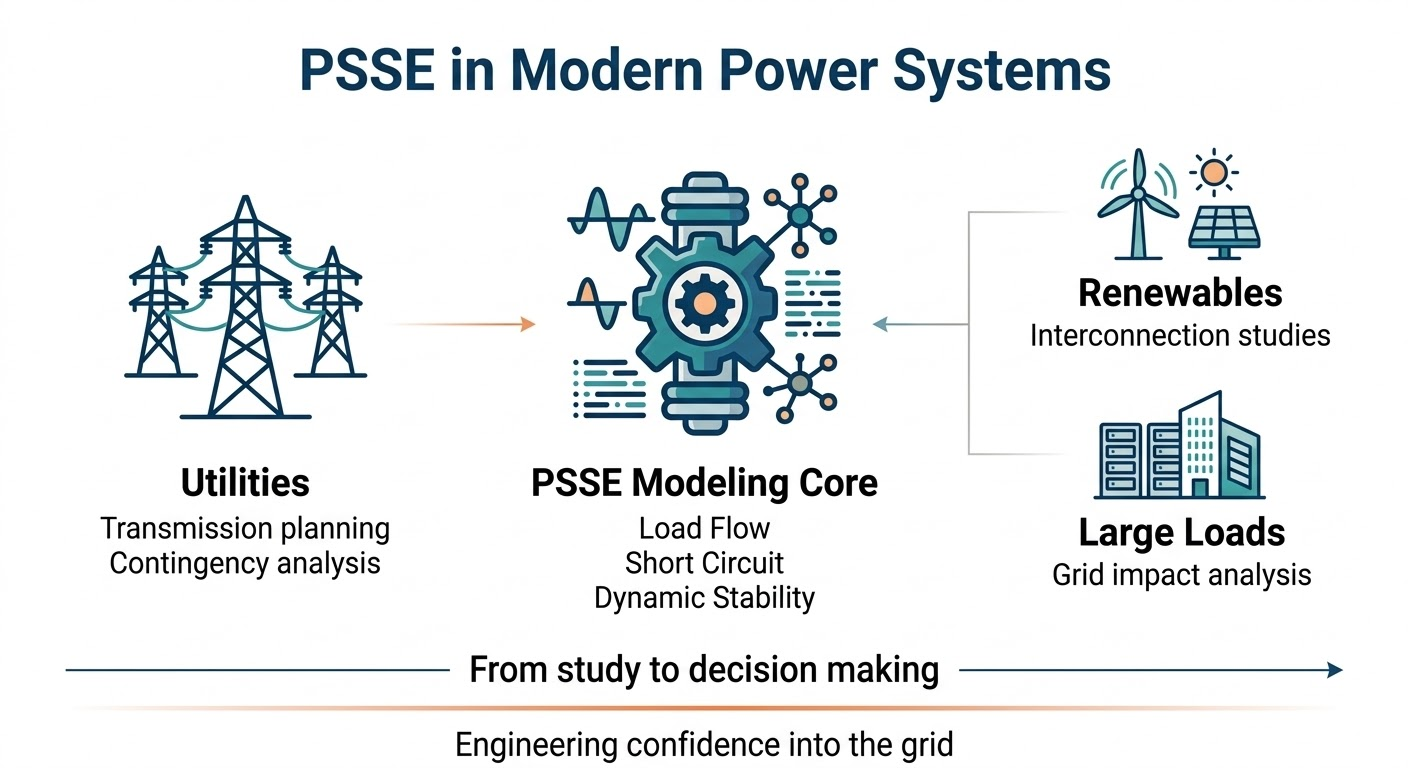
PSSE (Power System Simulator for Engineering) has long been the industry standard for power system modeling, simulation, and analysis. Its relevance has not diminished. If anything, it has increased as system complexity has grown.
At its core, PSSE allows engineers to:
- model power flow across transmission and distribution networks
- evaluate system response to contingencies (N-1, N-2 scenarios)
- assess short circuit behavior and fault levels
- analyze dynamic stability under transient conditions
These exercises directly influence:
- whether a project is approved in interconnection studies
- how transmission upgrades are scoped and costed
- how reliably a system performs once energized
In practical terms, PSSE is a gatekeeper for grid-connected infrastructure.
Why PSSE Matters More Today
The role of PSSE has expanded as the grid itself has evolved.
1. Increasing penetration of inverter-based resources
Large-scale renewable energy projects, solar, wind, and increasingly BESS, are changing how power systems behave. Unlike traditional synchronous generation, inverter-based resources introduce new dynamics that require more detailed modeling and validation.
PSSE remains central in evaluating:
- voltage stability under high renewable penetration
- system response to disturbances
- interactions between inverter-based resources and the wider grid
2. Growth of large, complex loads
Hyperscale data centers and industrial electrification are introducing load profiles that are both large and dynamic. These loads are no longer passive consumers of power. Their interaction with the grid must be understood before interconnection.
PSSE supports:
- load flow analysis for large load integration
- contingency analysis to assess system robustness
- identification of potential overloads and voltage violations
3. Tighter reliability and regulatory requirements
Utilities and system operators are operating under increasing scrutiny. Reliability standards, planning criteria, and regulatory expectations continue to evolve.
PSSE provides the analytical foundation for:
- transmission planning studies
- compliance with reliability standards
- defensible decision-making in regulatory environments
PSSE as a Decision Making Tool
A common misconception is that PSSE is simply a software platform used to “run studies.” In reality, its value lies in how its outputs are interpreted and applied.
A well-executed PSSE study answers critical project questions:
- Can the system accommodate this new generation or load?
- What upgrades are required, and where?
- How will the system behave under credible contingencies?
- Are there hidden risks that could impact long-term reliability?
The difference between a basic study and a high-quality one is not the software, it is the engineering judgment applied to the modeling assumptions, scenarios, and interpretation of results.
In complex environments, small modeling decisions can materially affect outcomes. Assumptions around load behavior, generation dispatch, system topology, and contingency selection all influence results. Poor assumptions can lead to:
- underestimation of upgrade requirements
- mischaracterization of system risk
- delays in project approval
- unexpected performance issues post-energization
This is where experience becomes critical.
Where PSSE Fits in Interconnection and Grid Planning Workflows
For most grid-connected projects, PSSE plays a central role across multiple stages:
Early-stage feasibility
- high-level load flow studies
- identification of potential constraints
- screening of interconnection options
System impact and interconnection studies
- detailed power flow and contingency analysis
- evaluation of thermal and voltage limits
- definition of required network upgrades
Detailed planning and design support
- refinement of system models
- validation of design assumptions
- coordination with utility and ISO requirements
Operational and expansion planning
- long-term scenario analysis
- evaluation of future system conditions
- support for phased development strategies
Across all stages, PSSE provides a consistent analytical framework that stakeholders, utilities, ISOs, developers, and consultants, understand and trust.
The Growing Importance of Integrated Modeling
One of the key shifts in recent years is the need for more integrated analysis.
Projects are no longer evaluated in isolation. Modern grid planning requires understanding how multiple elements interact:
- renewable generation
- battery storage systems
- large industrial and data center loads
- transmission constraints
- control and protection systems
PSSE forms the backbone of this analysis, but its effectiveness depends on how it is integrated with:
- dynamic modeling tools
- EMT studies where required
- detailed equipment data and control models
The objective is not simply to produce compliant study results, but to develop a realistic view of system behavior under both normal and stressed conditions.
From Results to Decisions
Ultimately, the value of PSSE lies in its ability to support decisions.
For utilities, it informs where and how to invest in network upgrades.
For developers, it determines project viability, timelines, and costs.
For large energy users, it provides confidence that their operations will be supported by a stable and reliable grid connection.
In all cases, the goal is the same: reduce uncertainty.
PowerTek’s Excellence
At PowerTek, PSSE is applied as part of a broader engineering and advisory approach to grid planning, interconnection studies, and power system analysis.
The focus is not only on executing studies, but on:
- building models that reflect real system conditions
- identifying risks early in the project lifecycle
- translating technical results into clear, actionable decisions
PowerTek supports utilities, renewable developers, and large load customers, including data centers, in navigating complex grid environments where accuracy, speed, and clarity are critical.
PSSE Remains Essential
Despite rapid innovation across the energy sector, the fundamentals of grid behavior have not changed. Power systems must still balance generation and load, remain stable under disturbance, and operate within physical limits.
PSSE continues to provide the framework for understanding those fundamentals.