
Why Harmonics Analysis Is Becoming Critical in Modern Data Centers
A Practical Perspective For Developers, Owners, Operators, And Power Stakeholders
As data center loads become denser and more power-electronics-heavy, harmonic risk is shifting from a technical footnote to a project-critical design issue.
The conversation around data center power is changing
When power strategy for data centers is discussed, the focus usually falls on familiar issues: available megawatts, interconnection constraints, backup generation, and speed to energization. These issues remain important but they are no longer the full picture.
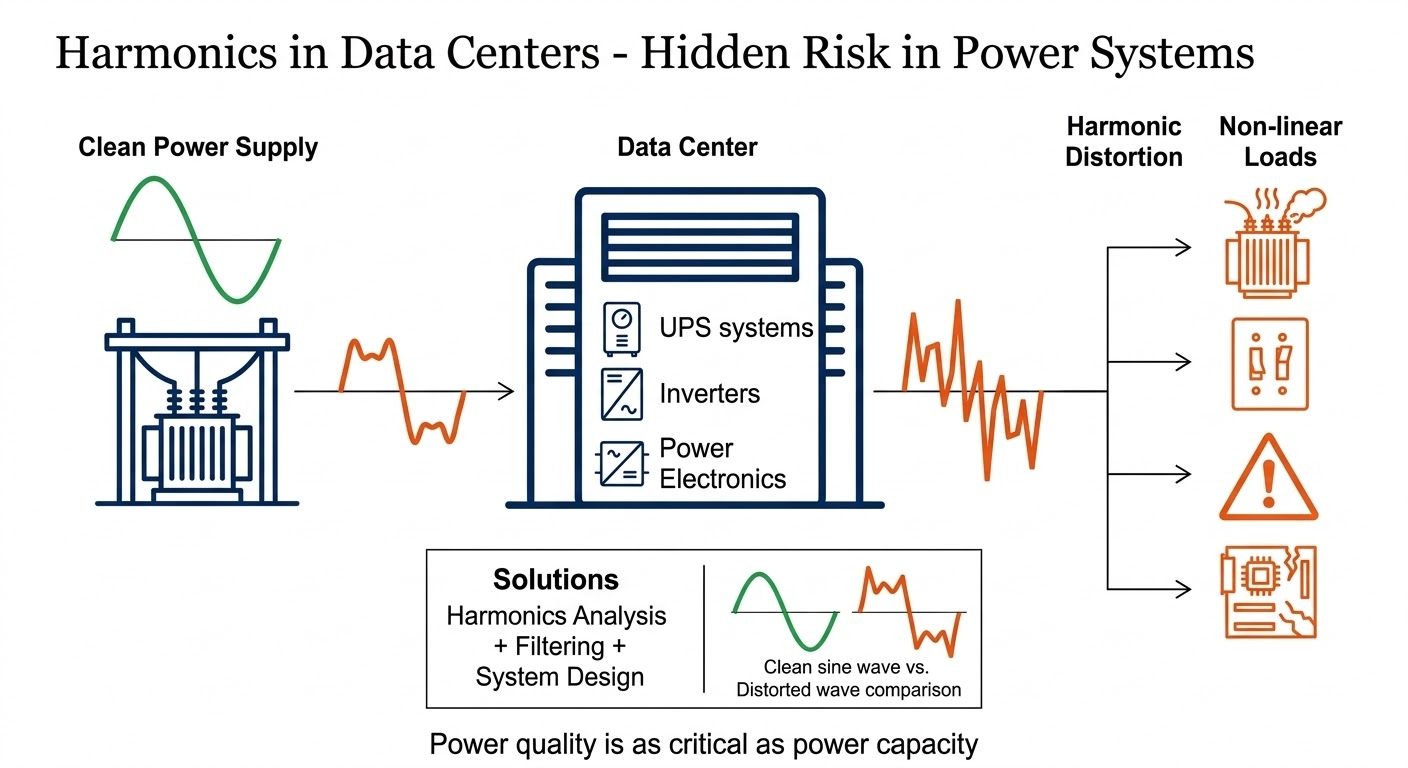
As modern facilities adopt more complex electrical architectures, power quality is becoming just as important as power capacity. In particular, harmonics analysis is moving from a late-stage engineering check to an early-stage system planning requirement.
This shift is being driven by the growing presence of non-linear loads across the data center environment. UPS systems, inverters, variable frequency devices, power conversion equipment, battery energy storage systems, and other power-electronic components can introduce distortion into voltage and current waveforms. In small or simple systems, the effect may be manageable. In large, dense, or highly integrated power systems, the consequences can be material.
Why harmonics matter more in modern data centers
Harmonics are not new. What is changing is the scale, density, and complexity of the systems in which they now operate.Large data centers are increasingly being developed with:
- higher concentrations of power-electronic equipment
- more dynamic load behavior
- tighter uptime requirements
- more layered backup and resiliency strategies
- closer interaction between utility supply, on-site generation, storage, and control systems
Harmonic distortion can contribute to overheating in transformers, cables, and switchgear. It can affect the performance of protective devices, lead to nuisance tripping, shorten equipment life, and create operating conditions that are difficult to diagnose after energization. In more complex systems, especially those that include BESS, microgrid controls, or hybrid architectures, the interaction between components can become difficult to predict without detailed study.
The key point is simple: a system can appear adequate from a capacity standpoint and still face avoidable reliability issues because power quality was not fully addressed.
Why this issue is becoming more urgent now
Three market shifts are pushing harmonics higher on the agenda.
First, data center development is accelerating into regions where interconnection is constrained and electrical designs are becoming more creative. Developers are looking at alternative supply strategies, temporary energization approaches, on-site generation, storage-backed configurations, and other hybrid models. These solutions can solve one problem while introducing another if the system is not studied properly.
Second, data center power systems are becoming more power-electronics-intensive by design. The growing use of inverter-based resources, advanced UPS configurations, and storage integration means that waveform distortion is no longer peripheral to the system. It is part of the system.
Third, tolerance for operational issues is low. At hyperscale, even a relatively narrow technical issue can have outsized operational and financial implications. A power quality problem that might be absorbed elsewhere can become material in a facility where uptime, redundancy, and equipment coordination are non-negotiable.
What many teams still miss
One common mistake is treating harmonics analysis as a box-checking exercise near the end of design. By that point, equipment selections have often been made, layouts are advanced, and mitigation options are narrower and more expensive.
Another mistake is analyzing components in isolation rather than evaluating the electrical system as an interacting whole. Harmonic behavior is shaped by the full network: source characteristics, transformer configurations, cable lengths, grounding, filter design, control behavior, and the interaction of multiple non-linear devices. Looking at one part without understanding the system can produce false confidence.
A third issue is relying too heavily on assumptions drawn from older facility models. Traditional electrical approaches do not always translate cleanly into modern data center environments that incorporate storage, inverter-based resources, and more sophisticated control architectures. The system may meet basic design expectations on paper while still carrying hidden performance or reliability risk.
What good practice looks like
Good practice starts early.
Harmonics analysis is most useful when it informs planning, not just validation. That means it should be incorporated during system architecture decisions, equipment selection, and design coordination, before the project becomes too rigid.
A sound approach usually includes:
- early identification of major non-linear load sources
- system-level modeling of expected harmonic behavior
- assessment of distortion limits and equipment sensitivity
- review of potential resonance and interaction risks
- coordination between utility supply characteristics and on-site systems
- evaluation of mitigation measures such as filtering, design adjustments, or equipment configuration changes
In high-reliability environments, study quality matters as much as study timing. The objective is not only to show compliance. It is to understand how the system is likely to behave in real operating conditions and how that behavior may evolve as the facility scales.
Why this matters for owners, developers, and operators
For owners and developers, the implication is clear: power quality should be considered part of project risk management, not just electrical design.
For operators, harmonics analysis supports more stable long-term performance, fewer avoidable failures, better protection coordination, and stronger confidence in system behavior under real load conditions.
For the broader supply chain, including EPCs, utilities, and major equipment providers, it improves alignment around what the electrical system needs to do, not just what individual components are rated to handle.
In practical terms, the facilities that perform best over time are unlikely to be the ones that focused only on securing power. They will be the ones that treated power quality as a core part of reliability from the start.
Power quality is becoming a strategic issue
As data center infrastructure grows in complexity, harmonics can no longer be treated as a secondary technical detail. They sit at the intersection of reliability, equipment performance, and system design integrity.
That is why harmonics analysis is becoming more important in modern data centers. Not because the concept is new, but because the consequences of getting it wrong are becoming harder to absorb.
In the next phase of data center development, securing enough power will remain essential. Ensuring that power is stable, coordinated, and clean will matter just as much.