
Why Grid and Transmission Planning Are Becoming More Critical Than Ever
A practical perspective for utilities, developers, and large energy users navigating a rapidly changing power system
Grid planning and transmission planning have always been central to how power systems evolve. What is changing now is the speed, scale, and uncertainty of demand.
Across utilities, renewable developers, and data center operators, pressure on the grid is building from multiple directions at once. Large-scale renewable integration is reshaping generation patterns. Data centers are introducing concentrated, high-intensity loads. Electrification is adding steady baseline demand that did not exist before.
This converges to a single question:
Can the grid deliver power reliably, where and when it is needed?
The shift from predictable growth to system complexity
Historically, grid planning followed relatively predictable patterns. Demand grew steadily. Generation sources were largely centralized and dispatchable. Transmission expansion, while complex, operated within a more stable framework.
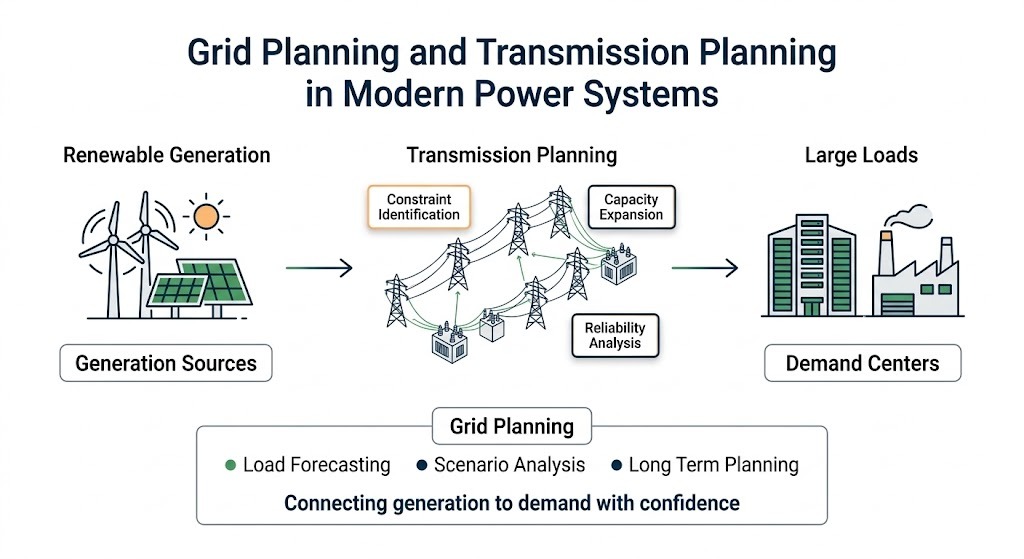
That environment no longer exists. Today’s grid must accommodate:
- variable renewable generation with intermittent output
- geographically constrained transmission capacity
- large, location-specific loads such as hyperscale data centers
- increasing electrification across transportation, industry, and buildings
These changes are not incremental. They fundamentally alter how power flows across the network and how planning decisions must be made.
The result is a system where uncertainty is higher, interactions are more complex, and the margin for error is smaller.
Why transmission planning is now a constraint
Transmission planning is no longer a background activity. It has become a critical path item for energy infrastructure development.
In many regions, transmission constraints are already limiting:
- the pace of renewable energy integration
- the feasibility of new data center developments
- the ability to electrify industrial processes
The issue is not simply a lack of infrastructure. It is a lack of visibility into how the system behaves under evolving conditions.
Transmission planning today requires more than identifying where new lines are needed. It requires:
- understanding how power flows across the network under different scenarios
- identifying constraints before they become bottlenecks
- evaluating trade-offs between reliability, cost, and long-term flexibility
Without this level of analysis, planning becomes reactive, and reactive planning is expensive.
The role of system studies in modern grid planning
At the core of effective grid planning is a simple principle: decisions are only as good as the underlying system analysis.
Modern transmission and grid planning rely heavily on detailed power system studies, including:
- load flow analysis to understand steady-state system conditions
- contingency analysis to evaluate system performance under outages
- short circuit analysis to assess fault levels and protection requirements
- dynamic and stability studies where system behavior under disturbance is critical
These studies are not isolated exercises. They inform:
- where transmission upgrades are required
- how new generation or load can be integrated
- what risks exist under different operating conditions
- how the system will perform over time as demand evolves
As systems become more interconnected and interdependent, the quality of these studies becomes increasingly important.
What effective grid planning looks like
Good grid planning is structured, forward-looking, and grounded in a clear understanding of system behavior.
In practice, effective planning involves:
Scenario-based analysis
Evaluating how the system performs under multiple conditions, including peak demand, renewable variability, and future load growth.
Early identification of constraints
Understanding where thermal, voltage, or stability limits may emerge before they impact projects.
Coordination across stakeholders
Aligning utilities, developers, large load customers, and system operators around a shared view of system capabilities and limitations.
Integration of new technologies
Incorporating renewable energy, battery storage, and advanced load profiles into planning models rather than treating them as edge cases.
Balancing short-term needs with long-term flexibility
Avoiding solutions that solve immediate constraints but create future limitations.
The objective is not just to expand the grid. It is to expand it intelligently.
The growing impact of large load connections
One of the most significant shifts in recent years is the rise of large, concentrated loads, particularly data centers.
Unlike traditional demand growth, these loads:
- can scale rapidly
- require high levels of reliability
- are often location-constrained
- interact dynamically with the grid
From a transmission planning perspective, this introduces new challenges:
- localized congestion and voltage impacts
- increased need for detailed interconnection studies
- tighter timelines for decision-making
- greater consequences if system behavior is not accurately understood
Grid planning must now account for these loads not as exceptions, but as core drivers of system evolution.
From planning to execution
A key challenge in transmission planning is translating analysis into action.
It is not enough to identify constraints. The real value lies in:
- defining practical upgrade pathways
- sequencing investments effectively
- aligning planning decisions with regulatory and commercial realities
- ensuring that recommended solutions can be implemented within project timelines
This requires not only technical modeling capability, but also experience in how planning decisions play out in real project environments.
PowerTek’s approach to grid and transmission planning
PowerTek supports utilities, renewable developers, and large energy users with grid planning, transmission planning, and interconnection analysis grounded in detailed system studies.
The focus is on:
- building accurate system models that reflect real operating conditions
- identifying risks early in the planning process
- translating technical results into actionable decisions
- supporting projects from initial feasibility through detailed study and execution
This approach ensures that planning outcomes are not theoretical. They are aligned with how projects are actually developed, approved, and operated.
Planning for a system that is still evolving
The power system is entering a period of sustained transformation. Demand is less predictable. Supply is more variable. Infrastructure constraints are more visible.
In this environment, grid and transmission planning cannot rely on legacy assumptions.
They must be:
- data-driven
- scenario-based
- integrated across technologies and stakeholders
The goal is straightforward but not simple:
“Build systems that perform reliably today, while remaining adaptable for what comes next”