
Energy Infrastructure Is Becoming the Constraint That Shapes Growth
A practical perspective on why grid capacity, transmission planning, and system readiness are now central to a project’s success
Energy infrastructure rarely attracts attention until it becomes a constraint.
That constraint is now visible across North America and beyond.
Projects are ready to move forward. Capital is available. Demand is clear. What slows progress is is whether the underlying system can support that growth. In many cases, the limiting factor is no longer financing, permitting, or technology. It is the ability of the grid to deliver power reliably, at the scale and location required.
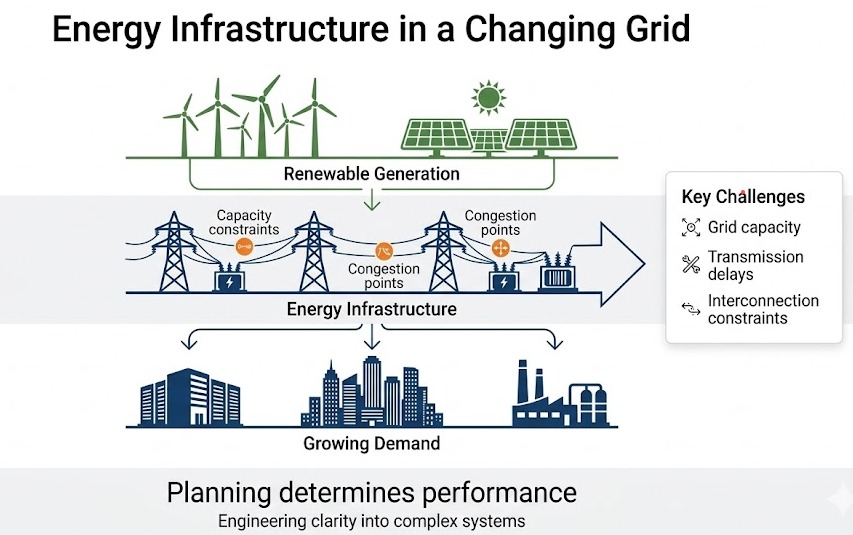
Demand is not only increasing. It is changing in structure.
What distinguishes the current moment is not simply the volume of demand, but its shape.
Renewable generation is being added at scale, often in locations that are distant from load centers. Data centers are introducing large, concentrated loads with strict reliability requirements. Electrification is increasing baseline demand across transportation, industry, and buildings.
Individually, each of these trends can be managed within existing planning frameworks. Together, they are testing how well those frameworks account for interaction, timing, and system limits.
The result is a grid that is being asked to do more, in ways it was not originally designed to accommodate.
Infrastructure is no longer a downstream consideration
Historically, infrastructure development often followed demand. Projects were conceived, and the grid was expected to adapt.
That sequencing is no longer viable.
Energy infrastructure today must be treated as a starting point. The ability to interconnect generation, serve large loads, and maintain system reliability depends on decisions made well before construction begins.
This shift places greater importance on:
- early-stage transmission and grid planning
- accurate system modeling and scenario analysis
- alignment between project development timelines and infrastructure readiness
Without this alignment, delays become inevitable. Not because projects are flawed, but because the system cannot support them when needed.
The cost of reactive planning is becoming visible
In constrained environments, infrastructure limitations do not always appear as outright failures. More often, they show up as delays, redesigns, and incremental costs that accumulate over time.
Common outcomes include:
- extended interconnection timelines
- unexpected network upgrade requirements
- reduced project flexibility due to system constraints
- operational compromises once assets are energized
These are not edge cases. They are increasingly common across markets where demand growth is outpacing infrastructure planning cycles.
What distinguishes projects that move forward efficiently
Projects that progress smoothly tend to share a consistent approach.
Infrastructure is treated as a core input, not an afterthought. Grid capacity is understood early. Constraints are identified before they become binding. Planning decisions are informed by how the system will actually operate, not just how it is expected to perform in ideal conditions.
This requires:
- detailed system studies to evaluate real operating scenarios
- early engagement with utilities and system operators
- coordination between developers, engineers, and planners
- a clear understanding of how different system elements interact
In practice, this approach reduces uncertainty. It allows projects to move forward with fewer revisions, more predictable timelines, and stronger alignment between design and reality.
The role of system studies in infrastructure readiness
At the center of this shift is the growing importance of system-level analysis.
Transmission planning, interconnection studies, and power system modeling are no longer technical formalities. They are the basis for determining whether a project is viable, how it should be designed, and what trade-offs are required.
Effective studies provide:
- visibility into system constraints under multiple scenarios
- clarity on required upgrades and their implications
- insight into how generation and load interact across the network
- a foundation for decisions that balance reliability, cost, and flexibility
The quality of these studies directly influences project outcomes. Strong analysis enables informed decisions. Weak or delayed analysis introduces risk that becomes difficult to manage later.
From uncertainty to a defined path forward
As energy systems become more complex, the gap between intent and execution widens when infrastructure is not fully understood.
Bridging that gap requires more than technical capability. It requires an approach that connects planning, engineering, and execution into a single, coordinated process.
PowerTek is deeply involved in this work. Through transmission planning, interconnection analysis, and detailed system modeling, the focus is on helping end users move from uncertainty to a defined path forward.
This involves:
- identifying constraints early in the project lifecycle
- evaluating realistic system behavior under different conditions
- translating study results into actionable planning decisions
The objective is not to produce analysis for its own sake. It is to enable projects to advance with clarity.
Infrastructure shapes outcomes, even when it is not visible
Energy infrastructure rarely fails in ways that are immediate or obvious. It does not typically draw attention through sudden breakdowns. Instead, it constrains, delays, and forces compromise.
Those effects are often subtle, but their impact on project timelines, costs, and performance is significant.
Well-planned infrastructure behaves differently. It enables growth without becoming a focal point. It supports new generation, new loads, and evolving system conditions without requiring constant adjustment.
In that sense, the measure of effective infrastructure is not how visible it is, but how little it limits what comes next.
Planning ahead is key
As demand continues to evolve and system complexity increases, energy infrastructure will play a more central role in determining which projects succeed and which stall.
The shift is clear:
- from reactive expansion to proactive planning
- from isolated decisions to integrated system thinking
- from assumptions to data-driven analysis
The projects that succeed in this environment will be those that treat infrastructure not as a constraint to be managed later, but as a foundation to be understood from the start.