
Transmission Planning Is Important in Modern Power Systems
A practical perspective on grid constraints, interconnection risk, and how transmission planning now defines which projects move forward
Transmission planning is becoming an important function in the power sector.
We are asking the grid to do things it was never designed for. Move large volumes of renewable generation across long distances. Support hyperscale data centers that can resemble small cities in terms of load. Absorb electrification across transport, industry, and buildings.
All of that converges on one layer of the system.
Transmission.
The grid is not constrained by demand. It is constrained by delivery
There is no shortage of demand for power.
What is constrained is the system’s ability to deliver it where and when it is needed.
Across North America, this is showing up in familiar ways:
- interconnection queues extending over multiple years
- transmission corridors operating close to limits
- projects facing unexpected upgrade requirements
- large loads competing for the same constrained capacity
These are structural issues and the underlying challenge is that demand is changing faster than the infrastructure designed to support it.
Demand is changing in ways the system was not built for
The current wave of demand is different in both scale and shape.
Renewable generation is being added at scale, often far from load centers. This introduces new transmission flows that were not originally anticipated.
Data centers are creating concentrated, high-intensity loads that require both capacity and reliability. Unlike traditional demand growth, these loads are location-specific and time-sensitive.
Electrification is increasing baseline demand in a steady, system-wide manner.
Individually, each of these trends is manageable. Together, they create a system that is more dynamic, less predictable, and more dependent on transmission performance.
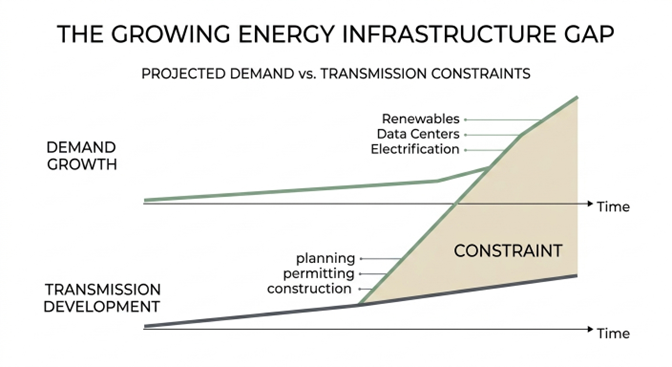
The real constraint is timing
The challenge is not just scale. It is timing.
Demand can emerge in a matter of years. Transmission infrastructure moves on much longer cycles; planning, permitting, regulatory approval, and construction.
This mismatch creates a gap.
That gap is where projects either move forward or stall.
In many cases, the issue is not whether infrastructure can be built. It is whether it can be built fast enough to align with project timelines.
Transmission planning sits directly in that gap.
Transmission planning is not a technical exercise
Historically, transmission planning was often viewed as a technical function; model the system, identify constraints, and define upgrades.
That framing is no longer sufficient.
Transmission planning today is a decision-making function that determines:
- which projects are viable
- how long they will take to connect
- what they will cost
- how reliable they will be once operational
This requires a shift from static analysis to dynamic, scenario-based thinking.
Good transmission planning does not stop at the base case. It considers:
- multiple load growth scenarios
- renewable variability and geographic dispersion
- contingency conditions (N-1, N-2 events)
- evolving system topology and interconnection pressure
The objective is not to describe the system as it exists today. It is to understand how it will behave under conditions that are still emerging.
Where transmission constraints become visible
Transmission constraints rarely present as immediate failures. They appear gradually, often only becoming clear when projects are already in motion.
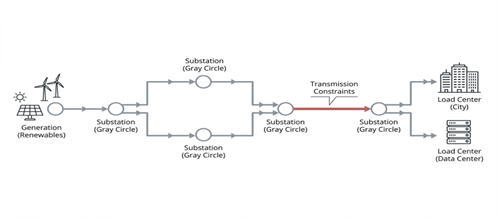
Common indicators include:
- limited available capacity at proposed interconnection points
- increasing scope and cost of network upgrades
- reduced flexibility in system operation under contingency conditions
- congestion that restricts power flow between regions
These constraints are often identified too late in the development process, when options are limited and timelines are compressed.
The value of transmission planning lies in identifying them early.
What differentiates projects that move forward
In practice, the difference between projects that progress and those that stall is rarely intent or capital.
It is clarity.
Clarity on:
- what the system can support today
- where constraints will emerge under future conditions
- what upgrades are required and how they will be sequenced
- how different investments interact across the network
Projects that establish this clarity early are able to:
- make informed siting decisions
- align timelines with infrastructure availability
- avoid late-stage redesigns
- move through interconnection processes with fewer surprises
Without this clarity, uncertainty compounds, and delays follow.
The role of power system studies in transmission planning
Transmission planning is only as strong as the system analysis behind it.
Detailed power system studies; load flow, contingency analysis, short circuit studies, and dynamic modeling, provide the foundation for understanding:
- system limits under current conditions
- how those limits change with new generation and load
- where upgrades will have the greatest impact
- how the system responds under stress
These studies are not standalone deliverables. They inform decisions that have long-term implications for reliability, cost, and scalability.
From analysis to actionable decisions
The challenge is not identifying constraints. It is translating analysis into decisions that can be executed.
This includes:
- prioritizing transmission upgrades based on system impact
- evaluating alternative pathways for interconnection
- sequencing investments to align with demand timelines
- balancing near-term needs with long-term system flexibility
Effective transmission planning connects engineering analysis with practical execution.
PowerTek’s approach to transmission planning
PowerTek works at the intersection of transmission planning, grid planning, and interconnection analysis, supporting utilities, renewable developers, and large load customers.
The focus is on:
- understanding system behavior under real operating conditions
- identifying constraints before they become limiting
- evaluating scenarios that reflect how the grid is evolving
- translating complex system dynamics into clear, actionable decisions
Transmission is where decisions are now being made
Transmission infrastructure is not always visible, but it is increasingly where outcomes are determined.
As demand continues to evolve and system complexity increases, the role of transmission planning will only grow.
The shift is already underway:
- from reactive expansion to proactive planning
- from static models to scenario-based analysis
- from isolated decisions to system-wide thinking
In this environment, transmission is not just part of the system but a layer of what the system can became.