
Dynamic Stability Studies Are Defining Grid Reliability in Modern Power Systems
A practical perspective on how PSSE, PSCAD, and dynamic system analysis determine whether power systems remain stable under real-world conditions
The grid does not fail during normal conditions.
It fails in the seconds after something goes wrong.
That is the part most models do not fully capture and where dynamic stability studies become critical.
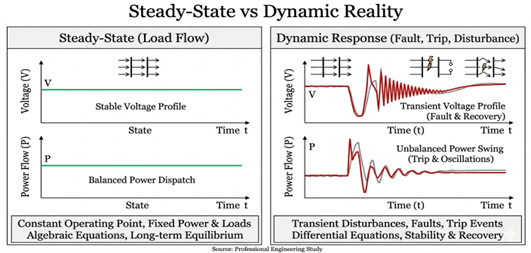
Stability is not proven at steady state
On paper, many systems appear stable. Load flows converge. Voltages sit within limits. Contingency checks pass. From a steady-state perspective, the system is operating as expected.
But steady-state analysis answers a limited question:
Can the system operate under normal conditions?
It does not answer the more important one:
What happens when conditions change suddenly?
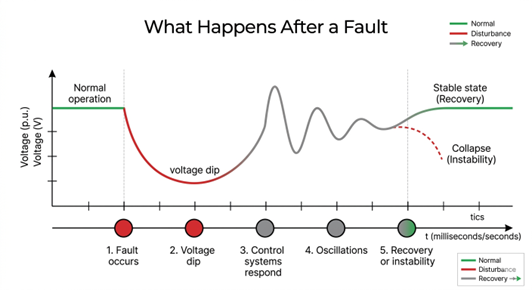
A fault occurs. A generator trips. A large load ramps or drops. Protection systems act. Controls respond.
In those moments, system behavior is defined by dynamics, not steady-state assumptions.
This is where stability is either maintained or lost.
What dynamic stability actually measures
Dynamic stability studies evaluate how the power system responds to disturbances over time.
This includes:
- voltage recovery following faults
- frequency response under generation or load imbalance
- rotor angle stability in synchronous machines
- control system interactions across inverter-based resources
- oscillatory behavior and damping performance
These events unfold over milliseconds to seconds. Their impact determines whether the system:
- returns to a stable operating point
- experiences sustained oscillations
- or begins to cascade into instability
In modern grids, these outcomes are increasingly influenced by fast-acting controls rather than mechanical inertia.
Why dynamic behavior is becoming more complex
The complexity of dynamic stability analysis has increased significantly in recent years.
Three structural shifts are driving this:
1. Inverter-based resources are changing system response
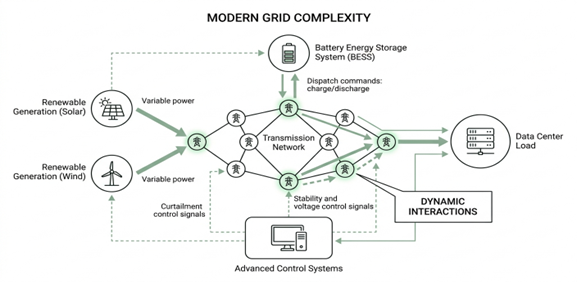
Solar, wind, and battery energy storage systems (BESS) do not behave like traditional synchronous generation. Their response is governed by control systems, not physical inertia.
This introduces:
- faster response times
- sensitivity to control tuning
- potential for interaction between multiple inverter-based assets
2. BESS and grid-forming technologies are introducing new dynamics
Battery systems can stabilize or destabilize the grid depending on how they are configured.
Dynamic studies are required to evaluate:
- grid-forming vs grid-following behavior
- fault ride-through performance
- interaction with existing generation and controls
3. Large, fast-changing loads are altering system behavior
Hyperscale data centers and industrial loads can change demand rapidly. These shifts influence:
- voltage stability
- frequency response
- interaction with upstream infrastructure
The net effect is a system where dynamic conditions are more frequent, more complex, and less predictable.
Where traditional studies fall short
Load flow and contingency analysis remain essential. They define system limits under steady conditions.
However, they do not capture:
- sub-second system behavior
- control system interaction
- transient oscillations and instability modes
- detailed response of inverter-based resources
This gap becomes critical in systems with:
- high renewable penetration
- significant BESS integration
- HVDC or hybrid AC/DC configurations
- large, dynamic loads
Dynamic stability studies, using tools such as PSSE dynamic simulations and PSCAD EMT modeling, are required to close that gap.
From validation to design input
Historically, dynamic stability studies were often performed late in the project lifecycle, primarily to confirm that a system met minimum requirements.
That approach is no longer sufficient.
Developers and utilities are now bringing dynamic studies into:
- early-stage planning
- control system design
- protection scheme development
- system configuration decisions
This shift reflects a simple reality:
It is far easier to design stability into a system than to correct instability after the fact.
When dynamic analysis is performed early, it enables:
- better tuning of inverter and control systems
- more robust protection coordination
- improved system resilience under disturbance
- reduced risk of late-stage redesign or operational issues
What effective dynamic stability analysis looks like
High-quality dynamic stability studies go beyond running simulations.
They require:
- accurate system models reflecting real operating conditions
- detailed representation of control systems and inverter behavior
- scenario-based analysis covering credible disturbances
- interpretation of results in an operational context
This includes evaluating:
- fault scenarios across different network locations
- generation and load variability
- interaction between multiple control systems
- system performance under stressed conditions
The objective is not simply to demonstrate compliance. It is to understand how the system behaves when it is pushed beyond normal operation.
Approach to dynamic stability studies
PowerTek supports utilities, developers, and large energy users through dynamic stability studies, PSSE modeling, and PSCAD EMT analysis focused on real-world system behavior.
The focus is on:
- identifying instability risks that are not visible in steady-state analysis
- evaluating control interactions across inverter-based resources and BESS
- modeling system response under realistic disturbance scenarios
- translating simulation results into actionable engineering decisions
This ensures that systems are not only approved, but stable and reliable once energized.
Stability is now a design problem
As power systems evolve, stability is no longer something that can be verified at the end of a project.
It must be designed from the beginning.
The increasing role of inverter-based resources, battery storage, and dynamic loads means that system behavior is defined by how components interact in real time.
In this environment:
- steady-state analysis defines feasibility
- dynamic stability analysis defines reliability
The distinction is critical.
The systems that perform are the ones that are understood
Most systems appear stable until they are tested.
The difference between those that recover and those that fail is rarely visible in early-stage assumptions. It emerges in how the system responds under stress.
That is why dynamic stability studies are becoming central to modern grid planning, interconnection analysis, and infrastructure development.
Because in today’s grid, stability is not proven on paper.
It is proven in motion.