
Why PSCAD Studies Are Becoming Essential for Modern Power System Design
A practical perspective on EMT modeling, grid stability, and dynamic system behavior in an increasingly complex grid
Most projects get approved with steady-state studies, but they get stress-tested in the real world. The gap between those two is where PSCAD becomes critical.Steady-state validation is no longer sufficient
Traditional power system studies; load flow, short circuit, and contingency analysis remain foundational. They determine whether a project can connect to the grid and operate within defined limits under normal conditions. However, these studies are inherently limited. They assume:- quasi-static system behavior
- simplified representations of controls
- averaged system responses over time
- inverter-based resources (solar, wind, BESS)
- fast-acting control systems
- high-density, power-electronics-driven loads such as data centers
- HVDC links and hybrid AC/DC architectures
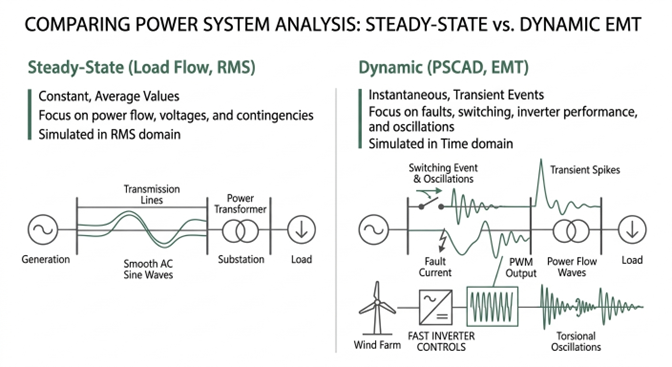
Why dynamic behavior is now central to grid reliability
As system complexity increases, risk shifts from steady-state violations to dynamic performance. Key concerns include:- control interactions between inverter-based resources
- fast transient events during switching and faults
- voltage and frequency instability under disturbance
- unexpected oscillations or resonance conditions
- protection misoperations driven by transient behavior
What PSCAD enables that other tools cannot
PSCAD studies go beyond steady-state and RMS-based simulations. They model the system at a much finer level of detail, capturing fast dynamics and electromagnetic transients. This includes:- switching events and transient overvoltages
- inverter control behavior and interaction
- detailed BESS response under charging/discharging cycles
- HVDC converter dynamics and commutation processes
- fault behavior and system recovery on sub-second time scales
Where PSCAD studies are now most critical
The need for PSCAD is most pronounced in systems where fast dynamics and control interactions dominate.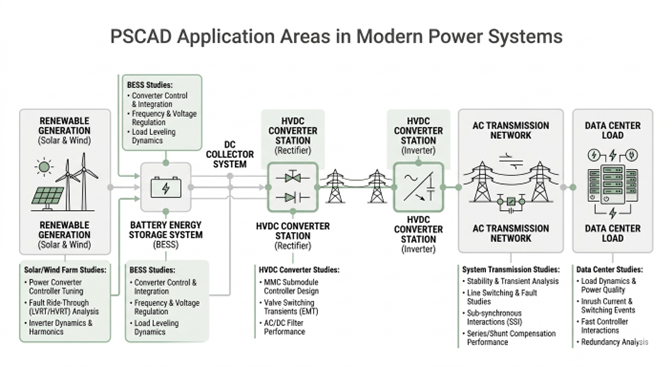
Battery Energy Storage Systems (BESS)
BESS introduces fast-response power electronics that can significantly influence system stability. PSCAD is used to evaluate:- control performance under transient conditions
- interaction with grid-forming and grid-following modes
- response to faults and switching events
Renewable energy integration
High penetration of inverter-based resources creates complex interactions that cannot be captured through simplified models. PSCAD enables:- detailed modeling of inverter controls
- evaluation of system stability under high renewable scenarios
- assessment of harmonic and transient behavior
HVDC systems and hybrid networks
HVDC links introduce converter-driven dynamics that require electromagnetic transient analysis. PSCAD supports:- converter interaction studies
- fault ride-through and recovery analysis
- coordination with AC network behavior
Data center and high-density loads
Large, power-electronics-heavy loads introduce rapid changes in demand and potential power quality issues. PSCAD helps evaluate:- system response to rapid load changes
- interaction with UPS systems and backup configurations
- transient impacts on upstream infrastructure
The shift from late-stage validation to early-stage decision support
Historically, PSCAD studies were often performed late in the project lifecycle, typically to satisfy specific utility or regulatory requirements. That approach is changing. Developers and utilities are now bringing PSCAD into:- early system design
- control strategy development
- equipment specification and configuration decisions
- informed selection of system architecture
- better alignment between control strategies and grid conditions
- reduced risk of redesign, delay, or performance issues
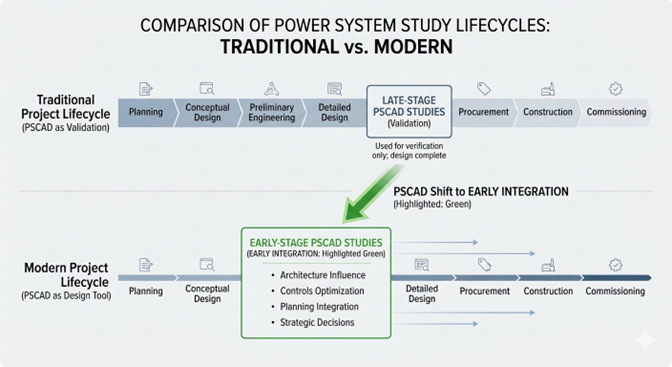
From model outputs to engineering decisions
The value of PSCAD is not in producing detailed waveforms. It is in what those results enable. Effective PSCAD studies translate into:- clearer understanding of system limits under transient conditions
- identification of control interactions that could impact stability
- improved coordination between generation, storage, and load
- more robust protection and control strategies
PowerTek’s approach to PSCAD and dynamic system studies
PowerTek supports utilities, developers, and large energy users through PSCAD studies, EMT modeling, and grid stability analysis aligned with real operating conditions. The focus is on:- building high-fidelity models that capture critical system dynamics
- identifying risks that are not visible in steady-state analysis
- evaluating interactions between inverter-based resources, BESS, HVDC systems, and large loads
- translating PSCAD results into actionable design and operational decisions
As systems become more dynamic, studies must evolve
Power systems are no longer defined by steady-state behavior alone. They are shaped by fast dynamics, control interactions, and transient events that occur in fractions of a second. In this environment:- steady-state studies remain necessary
- but they are no longer sufficient