
America’s Grid Is Becoming Strategic Infrastructure
Why grid modernization, transmission planning, and interconnection analysis now shape economic growth
For decades, America treated the electric grid as background infrastructure.
Reliable. Stable. Available when needed.
That assumption no longer holds.
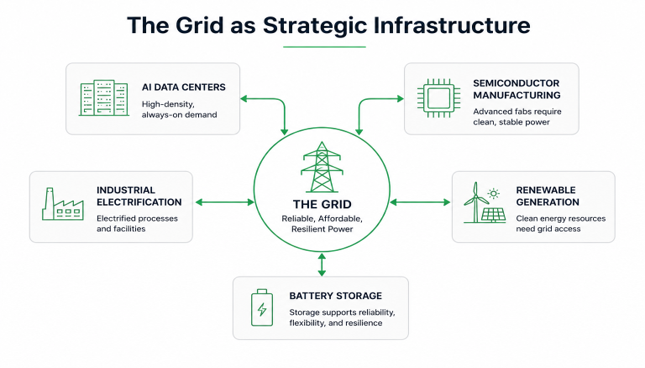
The grid now sits at the center of economic competitiveness, AI infrastructure, manufacturing expansion, energy security, and national resilience. Data centers need large blocks of firm power. Semiconductor plants need stable transmission infrastructure. Electrification adds load across transportation, buildings, and industry. Renewable energy adds more supply, but often far from where demand is growing.
Every major growth priority now runs through the grid.
The grid is no longer just a utility system
The electric grid has become a strategic platform for industry.
A region with available transmission capacity can attract data centers, factories, battery plants, and advanced manufacturing. A region with constrained infrastructure loses time, capital, and development options.
This is already visible in large-load planning. A hyperscale data center may need 100 MW, 300 MW, or more. That load can affect transmission flows, substation capacity, voltage support, short circuit levels, and regional planning assumptions. The question is no longer only whether power exists. The question is whether the system can deliver it reliably at the right location.
PowerTek sees this shift in large-load and interconnection work. The useful answer for clients is rarely a simple yes or no. It is a clear view of what the grid can support today, what changes at the next phase, and which constraints could affect schedule or cost.
The old planning model does not fit the new demand profile
America built much of its grid around a different operating model.
Demand growth was more predictable. Generation was more centralized. Load changes were slower. Transmission planning had more time to absorb system changes.
That model is under pressure.
AI data centers can create step changes in load. Manufacturing projects can cluster around available power. Electrification increases baseline demand. Renewable generation changes power flows across regions. Battery energy storage systems add flexibility, but also introduce new control and interconnection questions.
These changes affect how the system behaves.
A project can pass an early capacity screen and still face later issues. Transmission constraints may appear in contingency analysis. Voltage support may become a limiting factor. Protection settings may need revision. Dynamic studies may show behavior that a steady-state screen does not capture.
That is why grid modernization must start with system behavior, not equipment lists.
Modernization is a planning problem before it is a construction problem
Grid modernization is often framed as building more infrastructure.
That is only part of the answer.
The harder question is where to invest first. Which transmission corridors need expansion. Which substations limit growth. Which interconnection points carry the lowest project risk. Which constraints can be managed with operations, controls, or storage. Which ones require physical upgrades.
These are system decisions.
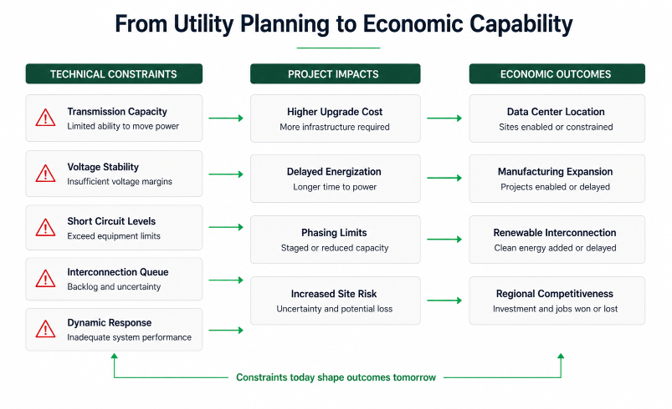
They require transmission planning, power flow studies, contingency analysis, short circuit review, voltage stability assessment, dynamic modeling, and interconnection studies. Each study answers a different question. Together, they show whether the network can support growth without weakening reliability.
PowerTek’s utility planning and system study work often starts here. A client may be evaluating a new load corridor, a renewable interconnection, or BESS integration. The work begins by identifying system limits, testing scenarios, and translating study results into decisions the project team can use.
Grid constraints now affect where capital goes
Infrastructure constraints do not always appear as outages.
They appear as delays. Upgrade costs. Interconnection uncertainty. Phasing limits. Lost site options. Longer development timelines.
For utilities, this creates pressure to plan ahead of demand. For developers, it changes how sites are screened. For large energy users, it makes power availability a board-level issue.
A strong grid modernization strategy gives decision-makers three answers:
- what the system can support now
- what upgrades are needed for the next stage of growth
- where investment reduces the most risk
Without that clarity, projects move forward on assumptions. Those assumptions become expensive when the grid study results arrive late.
The grid now defines capability
America’s grid is no longer just an electricity delivery system.
It determines where AI infrastructure scales. It influences where manufacturing expands. It affects how fast renewable energy connects. It shapes whether regions can support industrial growth without weakening reliability.
That is why transmission planning, interconnection reform, BESS integration, grid resilience, and dynamic system studies have moved from technical workstreams to strategic priorities.
The regions that plan the grid well will not just keep the lights on.
They will decide where the next wave of growth can happen.
PowerTek’s role in that work is practical: study the system, identify the constraints, test the scenarios, and give clients a clearer path forward.
The grid conversation is changing. It is no longer only about electricity.
It is about capability.