
A 100+ MW Data Center Is a Grid Event.
Why hyperscale data centers need grid analysis studies before capacity, schedule, and interconnection assumptions are locked
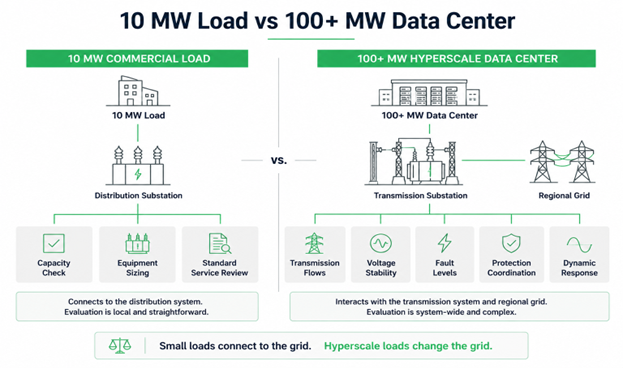
A 10 MW load behaves like a customer.
A 100+ MW data center behaves like part of the grid.
That distinction matters. At smaller scales, load interconnection follows a more predictable path. Capacity is reviewed, equipment is sized, and the project moves through utility coordination.
At hyperscale, the project changes the system around it.
A single 100+ MW campus can affect transmission flows, voltage performance, fault levels, protection settings, and regional planning assumptions. In some locations, it can influence how nearby substations, transmission corridors, and generation resources operate under both normal and contingency conditions.
That is why grid analysis studies now sit at the center of large-scale data center development.
Power availability is not the same as grid readiness
Securing access to power is only the first question.
The harder question is whether the surrounding grid can support the load reliably under real operating conditions.
A data center campus can look viable on a map. It can sit near transmission infrastructure. It can have a utility pathway and a preliminary capacity discussion. None of that proves the system can absorb the load without thermal overloads, voltage violations, protection issues, or network upgrades.
Grid readiness requires study.
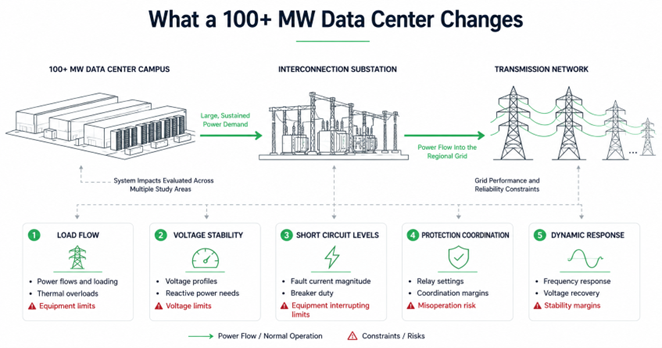
For a 100+ MW data center, the analysis should test load flow, contingency performance, short circuit levels, voltage stability, dynamic response, and power quality. These studies show how the system behaves when the project is not just connected, but operating.
That difference matters for schedule, cost, and reliability.
Large loads reshape the planning problem
Hyperscale data centers create planning questions that smaller loads rarely trigger.
A large campus can increase loading on specific transmission paths. It can change voltage support needs near the point of interconnection. It can alter fault levels at nearby buses. It can require protection coordination changes across utility and customer-owned assets.
The planning issue becomes larger when the campus grows in phases.
A first 100 MW block may be manageable. The next 100 MW may require a different substation configuration, transmission upgrade, or operating limitation. A third phase may change the regional plan altogether.
That is why early grid analysis should not only test the first energization date. It should test the full development trajectory.
PowerTek has seen this in large-load and utility planning work. The useful answer is often not a simple yes or no. It is a phased view of what the grid can support today, what changes at the next capacity block, and which constraints could affect future expansion.
The risk usually appears late
Most data center grid risk appears after major commitments are made.
The site has been selected. Commercial timelines are set. The load ramp has been promised. Equipment planning has started. Only then do study results reveal upgrade exposure, fault duty issues, voltage constraints, or protection coordination gaps.
At that point, the project has fewer options.
A late transmission upgrade can affect energization dates. A short circuit issue can affect breaker selection and protection design. A voltage stability concern can change reactive power needs. A dynamic response issue can require revised controls or operating limits.
These are engineering questions before they become commercial problems.
A strong grid analysis study brings them forward, while the project can still adjust site strategy, phasing, interconnection design, and utility engagement.
What a data center grid analysis study should cover
A useful data center grid analysis study connects technical findings to project decisions.
For a 100+ MW data center, that usually includes:
- load flow analysis under normal and peak conditions
- contingency analysis for key transmission and substation outages
- voltage stability and reactive power assessment
- short circuit and breaker duty review
- protection coordination across utility and customer interfaces
- dynamic stability analysis for load ramps and disturbance response
- power quality review, including harmonics and flicker where relevant
- phased interconnection review for future load growth
- upgrade risk and schedule impact assessment
The output should help the project team answer practical questions.
Which point of interconnection carries the lowest risk? What system upgrades may be required? How should the campus phase its load ramp? Which constraints could affect future capacity? Where should the utility engagement focus first?
PowerTek’s work with utilities, developers, and large-load customers focuses on this translation. The firm uses grid planning, interconnection analysis, and system studies to turn complex network behavior into decisions clients can act on.
Data centers now affect the grid around them
The central question has changed.
For smaller loads, the question is: can the grid serve the customer?
For hyperscale data centers, the question is: how does the customer change the grid?
That shift is not theoretical. A 100+ MW load can influence regional transmission planning, interconnection sequencing, protection settings, voltage support requirements, and generation development around it.
The projects that move with fewer surprises tend to study these issues early. They do not wait for the formal process to reveal whether the system works. They test the grid before the project becomes locked around assumptions.
At 100+ MW scale, power is not just a utility input.
It is a system constraint, a planning variable, and a project risk.
The right site is not only where land, fiber, and power appear available.
It is where the grid can support the campus, recover from disturbances, and grow with the load.