
Interconnection Studies Are Now a Strategic Gate in Energy Infrastructure Development
Why early grid analysis matters for renewables, BESS, data centers, and large load projects
Most projects do not fail because the technology is weak.
They fail because the grid was not understood early enough.
That pattern is becoming visible across renewable energy, battery energy storage systems, hyperscale data centers, and large industrial load projects. Developers secure land, select equipment, line up financing, and advance schedules before the surrounding system has been studied in enough detail.
Then the grid answers back.
Transmission constraints appear. Network upgrade costs increase. Fault levels change equipment requirements. Voltage performance limits project size. Interconnection queues become bottlenecks rather than process steps.
At that point, the project still may be viable, but it is no longer the same project.
Interconnection is not just a procedural step
Interconnection studies now sit at the center of project development.
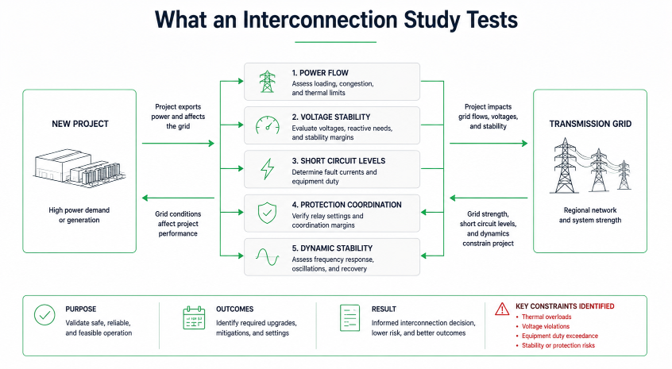
A proper interconnection study does more than check whether capacity exists near a point on the map. It tests how a new project changes the wider network.
That includes:
- power flow and thermal loading
- voltage response and reactive power needs
- short circuit levels and breaker duty
- protection coordination at the point of interconnection
- dynamic stability under faults and contingencies
- system impact under future load and generation scenarios
These questions affect project cost, schedule, and technical risk.
For a solar plant, the study may define network upgrades and reactive support needs. For a BESS project, it may reveal charging constraints and protection issues. For a data center, it may show whether a 100+ MW load changes nearby transmission flows or voltage stability.
The study does not only support approval. It shapes the project.
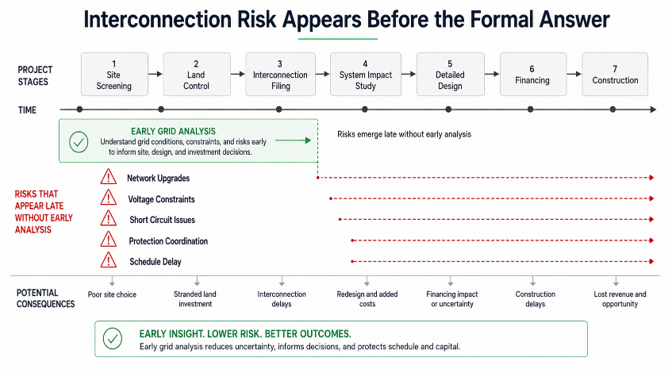
The biggest risks appear before the formal study result
The formal interconnection process gives developers an official answer.
The smarter move is to find the likely answer before entering that process.
A site can look strong because it sits near a substation or transmission corridor. That does not mean the location has usable headroom. Nearby circuits may be constrained. Other queued projects may change available capacity. A contingency case may trigger upgrades that a map screen will never show.
Early interconnection analysis gives developers more options.
They can compare points of interconnection. They can adjust project size. They can phase capacity. They can decide whether land should be pursued, paused, or dropped.
PowerTek has seen this repeatedly in generation interconnection work. In the PJM footprint, PowerTek supported more than 400 generation interconnection studies across roughly 130 GW of proposed projects. The projects that moved better were rarely the ones with the most aggressive schedule. They were the ones that understood the grid before major assumptions became fixed.
Modern projects create system interactions that older assumptions miss
The grid is no longer a passive host for new projects.
Renewable generation changes power flows. BESS changes timing and fault behavior. Data centers introduce large, concentrated loads. Industrial electrification adds new baseline demand. Each project type affects the network differently.
That makes assumptions riskier.
A steady-state screen may not show dynamic stability risk. A simple capacity check may miss protection coordination issues. A nearby substation may still require costly upgrades. A technically feasible interconnection may carry a schedule risk that weakens the commercial case.
This is why PowerTek treats interconnection studies as decision tools, not paperwork.
A useful study should tell the project team what the system can support, where the risks sit, and which decisions need to happen before capital is committed.
What a strong interconnection study should answer
A strong study connects engineering results to project decisions.
It should answer five practical questions:
- Which point of interconnection carries the lowest technical risk?
- What network upgrades may be required?
- What constraints appear under contingency conditions?
- How do fault levels, protection settings, and voltage support affect design?
- How could future queue activity or load growth change the project?
For utilities, these answers support reliable planning. For developers, they support site selection, financing assumptions, and schedule planning. For EPCs, they reduce late design changes. For hyperscalers and large load customers, they clarify whether the grid can support the campus as it scales.
In PowerTek’s work with utilities, EPCs, BESS sponsors, renewable developers, and large-load customers, the most useful output is often a ranked view of risk. It helps clients decide where to proceed, where to redesign, and where to avoid avoidable exposure.
Early engineering protects project economics
Interconnection risk becomes expensive when it is discovered late.
A late network upgrade can change project economics. A short circuit issue can change equipment selection. A voltage problem can change reactive power requirements. A dynamic stability issue can change controls, protection, or operating limits.
Early engineering does not remove every risk.
It makes the risk visible while the project still has choices.
That is why interconnection studies now matter more than ever. They sit between development ambition and grid reality.
The question is no longer only, “Can this project connect?”
The better question is, “What does the project do to the system, and what will the system require in return?”
Projects that answer that question early move with more clarity.
Projects that answer it late often pay for the delay.