
Why Data Center Power Studies Are Becoming the Deciding Factor in Project Success
A practical perspective on grid interconnection, power quality, UPS sizing, and resilience in mission-critical infrastructure
Most discussions around data center development focus on speed, location, and access to power.
What is often underestimated is how much of the project risk sits in the power studies behind the scenes.
Grid interconnection is only one part of the equation. The more critical question is how the electrical system will behave once the facility is operational; under real conditions, not ideal assumptions.
For mission-critical infrastructure, this distinction is not an academic exercise but a real one. It determines whether a facility performs as designed or becomes constrained by issues that were not fully understood at the planning stage.
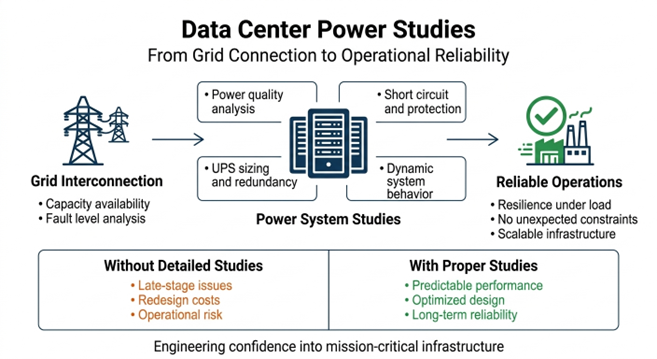
Power availability does not guarantee system performance
Securing megawatts is a milestone.
Data centers operate in environments where reliability requirements are absolute. Downtime is not tolerated, and even minor electrical issues can have outsized operational consequences.
Yet many risks emerge not from lack of power, but from how power behaves within the system.
These include:
- power quality issues driven by non-linear loads and harmonics
- incorrect UPS sizing relative to real load profiles and transient conditions
- elevated fault levels that impact protection coordination
- instability in systems with layered redundancy and backup configurations
- interaction risks in colocation facilities with multiple tenants and variable loads
These are predictable outcomes when systems are not studied with sufficient depth.
The scope of modern data center power studies
Data center power studies have expanded significantly in scope.
They are no longer limited to satisfying interconnection requirements. They now form the analytical foundation for how facilities are designed, configured, and operated.
A comprehensive approach typically includes:
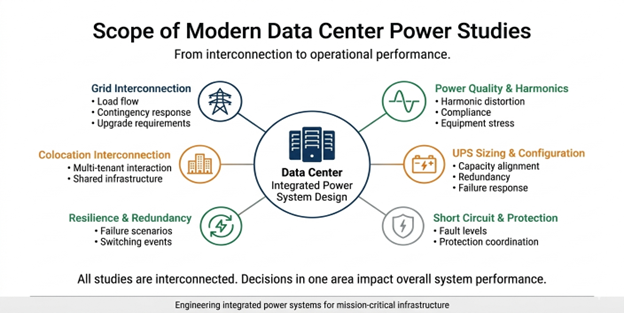
These studies are interconnected. Decisions in one area affect outcomes in others. Treating them as isolated tasks introduces risk.
Why developers are changing their approach
A clear shift is underway in how data center developers and operators approach power system studies.
Historically, these studies were often treated as requirements for approval, necessary to secure interconnection and move projects forward.
Today, they are becoming central to decision-making.
Developers are asking more detailed questions:
- How will the system behave under real operating conditions, not just peak scenarios?
- What are the long-term implications of current design choices?
- Where are the hidden risks that could impact reliability or scalability?
- How will the system perform as loads evolve over time?
This shift reflects a broader recognition: the cost of getting power system design wrong is significantly higher than the cost of studying it properly.
Where projects encounter avoidable risk
In practice, most issues arise not from a lack of analysis, but from the timing and depth of that analysis.
Common patterns include:
- power quality studies performed late, after major design decisions are fixed
- UPS sizing based on nominal assumptions rather than real load behavior
- limited evaluation of fault levels and protection coordination under changing system conditions
- insufficient modeling of redundancy and switching scenarios
- underestimation of interaction risks in colocation facilities
These gaps are rarely visible during early development stages. They emerge during commissioning or operation, when options are more limited and costs are higher.
What effective power study integration looks like
Projects that perform reliably over time tend to follow a different approach.
Power system studies are integrated early and used to inform design decisions, not validate them after the fact.
This includes:
- incorporating power quality analysis during system architecture design
- aligning UPS sizing with realistic load and transient scenarios
- evaluating fault levels and protection schemes before finalizing equipment selection
- modeling redundancy and resilience under multiple failure conditions
- assessing colocation interconnection dynamics as part of overall system planning
The goal is not to eliminate risk entirely but to also understand it early enough to manage it effectively.
The role of resilience analysis in mission-critical infrastructure
Resilience is often described in terms of redundancy: N+1, 2N, or other configurations.
In reality, resilience is defined by how the system behaves under stress.
Resilience analysis focuses on:
- system response to component failures
- switching behavior during fault or maintenance events
- interaction between primary, backup, and storage systems
- recovery time and operational continuity
For mission-critical infrastructure, these are operational requirements.
PowerTek’s approach to data center power studies
PowerTek supports developers, operators, and investors in delivering data center power studies, power quality analysis, UPS sizing, and mission-critical infrastructure assessments aligned with real-world operating conditions.
The focus is on:
- building accurate system models that reflect actual behavior
- identifying risks that are not immediately visible
- integrating grid interconnection, power quality, and resilience analysis into a unified framework
- translating technical results into clear, actionable decisions
This approach supports both project development and long-term operations, ensuring that systems are not only approved, but perform as expected once energized.
Understanding power is the differentiator
Access to power will continue to define where data centers can be built.
Understanding power will define how well they operate.
As electrical systems become more complex and performance requirements remain uncompromising, the role of detailed data center power studies will only grow.
The distinction is straightforward:
Projects that treat power studies as a requirement may secure approval.
Projects that treat them as a decision tool are more likely to operate reliably at scale.