
Aging Grid Infrastructure Is Becoming the Constraint on Energy System Growth
A practical perspective on how utilities can prioritize transmission upgrades, manage reliability risk, and plan for evolving demand
Aging infrastructure is no longer a background issue. It is becoming the limiting factor in how fast the grid can evolve.
Across North America, a significant portion of transmission lines, substations, and protection systems was built for a different operating environment. Demand was stable. Growth was predictable. Generation was centralized and dispatchable.
That model no longer holds.
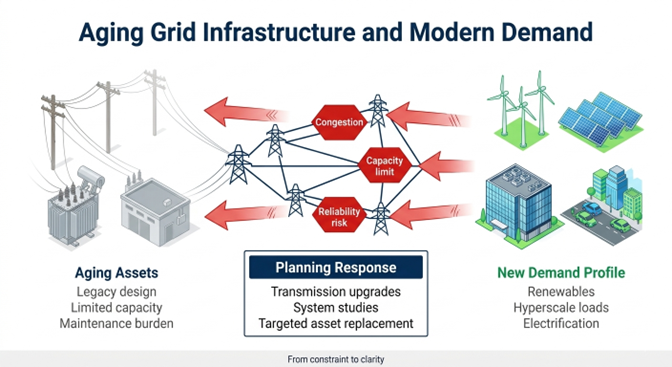
The system was not designed for today’s demand profile
The modern grid is being asked to support conditions it was not originally designed to accommodate.
Utilities are now managing:
- renewable generation with variable and location-dependent output
- large, concentrated loads from data centers and industrial electrification
- sustained baseline demand growth across multiple sectors
Each of these introduces new stress points across the system. Together, they fundamentally change how power flows, how assets are utilized, and how reliability must be maintained.
Aging infrastructure becomes critical in this context, not simply because it is old, but because it was designed for a different set of assumptions.
The constraint is not always visible, but it is measurable
Infrastructure limitations rarely present as immediate failures. More often, they appear as constraints.
These constraints take several forms:
- reduced available transmission capacity in key corridors
- limited flexibility in managing power flows under changing conditions
- increased sensitivity to contingencies and system disturbances
- growing reliance on operational workarounds to maintain reliability
In many cases, assets continue to function within nominal limits. The issue is that those limits are increasingly binding.
This is where aging infrastructure transitions from a maintenance issue to a planning constraint.
Why asset age alone is not the right lens
A common response to aging infrastructure is to focus on replacement cycles. While asset condition is important, it is not sufficient as a primary decision variable.
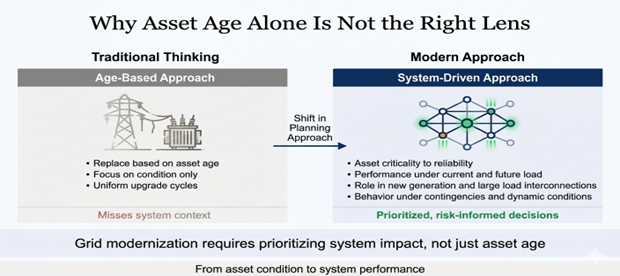
In practice, relatively newer assets can become constraints if they are located in high-growth areas or along critical transmission paths. Conversely, older assets may continue to perform adequately if they are not exposed to evolving system pressures.
Effective grid modernization requires a shift from age-based replacement to system-driven prioritization.
The role of transmission planning and system studies
Addressing aging infrastructure in a meaningful way requires a detailed understanding of how the system behaves under real conditions.
Transmission planning and power system studies provide that foundation.
Key analyses include:
- load flow studies to assess steady-state capacity and constraints
- contingency analysis to evaluate system resilience under outages
- short circuit studies to understand fault levels and protection requirements
- dynamic stability analysis where system response to disturbances is critical
These studies enable utilities to:
- identify where constraints are emerging or likely to emerge
- quantify the impact of new load and generation on existing assets
- evaluate alternative upgrade or reinforcement strategies
- prioritize investments based on system impact rather than asset age
Without this level of analysis, modernization efforts risk being reactive and misallocated.
From reactive upgrades to prioritized investment
The shift underway is strategic.
Utilities are moving from:
replacing assets based on condition
to
investing based on system need and future demand trajectory
This requires integrating multiple dimensions:
- asset condition and remaining life
- system criticality and redundancy
- load growth projections and interconnection pressure
- long-term planning scenarios, including renewable integration and electrification
The objective is not to modernize the entire system at once. It is to focus on the parts of the system where constraints will have the greatest impact on reliability and growth.
Where projects succeed
The implications of infrastructure constraints are most visible in project development.
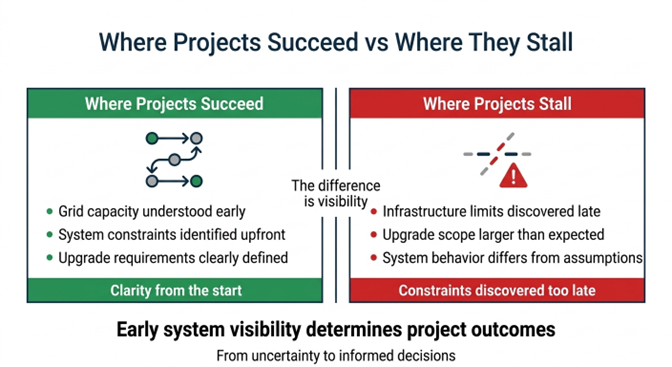
In both cases, the difference is not intent but visibility.
PowerTek’s approach to aging infrastructure and grid modernization
PowerTek supports utilities in addressing aging infrastructure through transmission planning, interconnection analysis, and detailed system modeling.
The focus is on:
- understanding how existing assets perform under current and future conditions
- identifying constraints that are not immediately visible
- prioritizing upgrades based on system impact and long-term value
- translating technical analysis into actionable planning decisions
This approach enables utilities to move from reactive asset management to structured, forward-looking investment strategies.
Infrastructure limits define the pace of transition
Energy infrastructure does not typically fail in ways that are immediate or obvious.
Capacity becomes constrained. Flexibility is reduced. Operational margins tighten. Over time, these effects shape what the system can and cannot support.
As demand continues to evolve, the pace of grid transformation will be defined less by ambition and more by infrastructure readiness.
The earlier those limits are understood, the more options utilities have to address them.
Planning ahead creates optionality
The central challenge is not the existence of aging infrastructure. It is the timing of decisions.
When constraints are identified early:
- upgrade pathways can be evaluated more effectively
- investments can be sequenced over time
- alternative solutions can be considered
That is why grid modernization is ultimately a planning problem as much as it is an engineering one.
The path forward
As utilities navigate increasing demand, evolving generation profiles, and infrastructure constraints, the need for disciplined, system-level planning will continue to grow.
The shift is clear:
- from asset-focused thinking to system-focused decision-making
- from reactive upgrades to prioritized investment strategies
- from static assumptions to scenario-based analysis
In this environment, the goal is not simply to replace what is aging. It is to build a system that can support what comes next.