
NERC Compliance Is An Operating Discipline
A practical perspective on aligning reliability standards with real-world system operations
NERC compliance is often treated as a checklist.
In reality, it functions much closer to an operating discipline.
The challenge is maintaining alignment between those standards and how the system is actually run day to day. Procedures are written. Systems evolve. Responsibilities shift. Over time, small gaps emerge between what is documented and what is happening in practice.
Those gaps are where risk accumulates.
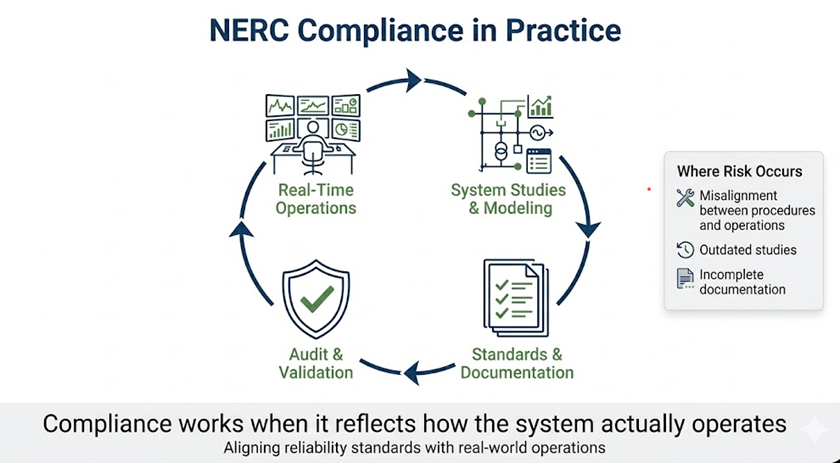
The gap between documentation and operations
Reliability standards are designed to reflect how power systems should be operated under normal and contingency conditions. They define expectations around planning, operations, protection systems, cybersecurity, and asset management.
On paper, most organizations have the required documentation in place.
The difficulty lies in execution.
As systems evolve, the following patterns are common:
- operating procedures no longer reflect current system configurations
- studies are completed, but assumptions are not revisited as conditions change
- responsibilities are distributed across teams without consistent ownership
- evidence required for compliance is not captured in a way that reflects actual operations
None of these issues are dramatic in isolation. Together, they create misalignment between compliance posture and operational reality.
This is the space where both audit findings and reliability risks tend to originate.
Why this challenge is becoming more complex
The complexity of maintaining NERC compliance has increased alongside the complexity of the grid itself.
Several shifts are driving this change:
Increasing penetration of renewable energy
Variable generation introduces new operating conditions that must be reflected in planning studies, operating procedures, and system models.
Changing transmission flows
Power is moving across the network in ways that were not anticipated when many procedures were originally developed. This affects contingency analysis, outage coordination, and system limits.
Growth of digital systems and automation
SCADA systems, EMS platforms, and digital controls are becoming more integrated into operations. This increases the importance of accurate data, system configuration management, and traceability.
Expanding cybersecurity requirements
NERC CIP standards continue to evolve, requiring tighter control over assets, access, and system integrity. Cybersecurity is no longer a parallel function. It is embedded in how systems are operated.
In this environment, compliance cannot remain static. It has to evolve with the system.
Where risk actually lives
It is a common assumption that compliance risk is concentrated around major gaps or missing documentation. In reality, risk is more often found in the small disconnects between processes.
Examples include:
- a study that was valid when completed but no longer reflects current system conditions
- an operating procedure that has not been updated after a configuration change
- evidence that demonstrates compliance on paper but does not reflect how tasks are actually performed
- reliance on individual knowledge rather than structured, repeatable processes
These are not failures of intent. They are the natural result of complex systems evolving over time.
The issue is not that standards are misunderstood. It is that maintaining alignment requires continuous effort across multiple functions.
Compliance as an integrated function
Utilities that manage NERC compliance effectively tend to approach it differently.
Rather than isolating compliance as a separate activity, they integrate it into core operational and engineering processes. This includes:
Planning and system studies
Ensuring that planning models, assumptions, and study outputs are consistent with reliability standards and are updated as conditions change.
Operations and outage coordination
Aligning real-time and planned operations with documented procedures, and ensuring that those procedures reflect current system conditions.
Protection systems and controls
Maintaining coordination between protection settings, system configuration, and compliance requirements.
Data and documentation management
Capturing evidence in a way that is accurate, traceable, and directly tied to actual activities.
In this model, compliance is not an additional layer of work. It is embedded in how work is performed.
From audit preparation to operational alignment
A common approach to NERC compliance is to focus on audit readiness. Documentation is assembled. Evidence is organized. Gaps are addressed in advance of formal review.
While this approach can be effective in the short term, it does not address the underlying issue if operational alignment is not maintained.
A more durable approach focuses on:
- ensuring that procedures reflect current system conditions
- aligning studies and models with actual operating practices
- establishing clear ownership of responsibilities
- embedding evidence capture into normal workflows
When this alignment is in place, audits become a reflection of how the system is actually managed, rather than an exercise in reconstruction.
The role of engineering and system understanding
At its core, NERC compliance is tied to how well the system is understood.
Standards related to transmission planning, system operations, protection, and cybersecurity all depend on accurate models, clear procedures, and coordinated execution.
Engineering analysis plays a central role in:
- validating system behavior under different conditions
- identifying risks before they materialize
- ensuring that documented limits and procedures are grounded in reality
Without this foundation, compliance becomes disconnected from system performance.
PowerTek’s approach
PowerTek supports utilities in aligning NERC compliance, system operations, and engineering analysis in a way that reflects real-world conditions.
The focus is not limited to audit preparation. It includes:
- reviewing and validating system studies and assumptions
- aligning operational procedures with current system configurations
- supporting outage coordination and system modeling efforts
- ensuring that compliance evidence reflects actual practice
The objective is to reduce the gap between documentation and operations, so that compliance becomes a natural outcome of how the system is managed.
Compliance and reliability are not separate
The distinction between compliance and reliability is often overstated.
Compliance defines expectations. Reliability reflects outcomes.
When systems are well understood, procedures are current, and operations are aligned with standards, the two tend to converge.
When they are not, compliance can appear intact while underlying risks remain.
That is why treating NERC compliance as an operating discipline is not simply a matter of process. It is a way of ensuring that reliability standards are not only documented, but consistently achieved in practice.