The BESS Site Selection Mistake That Can Break Project Economics
Why grid feasibility studies should come before land acquisition, interconnection filing, and commercial commitments
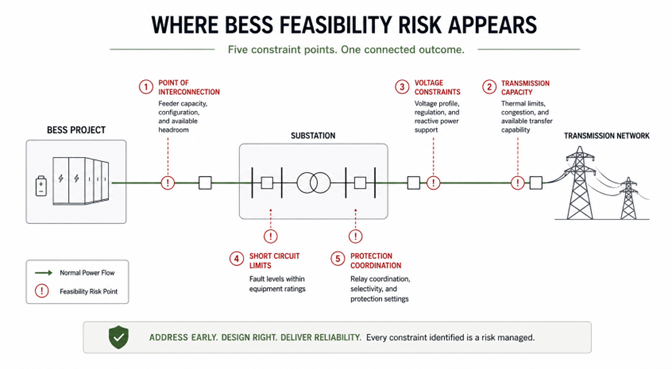
The biggest risk in many battery energy storage system projects appears after the site already looks attractive. It is not the battery technology. It is not the financing. It is the grid. Many BESS projects begin with a simple screen: land availability, parcel cost, zoning, proximity to a substation, and apparent access to transmission infrastructure. That process can identify sites that look viable on a map. It does not confirm that the grid can absorb the project. That gap matters. A storage project can have the right land, the right commercial thesis, and the right development team, but still fail because the interconnection point carries hidden constraints. Limited transmission capacity, congested substations, short circuit limits, protection issues, or network upgrade requirements can change the economics before the project reaches financial close. The right BESS site is not just where the land works. It is where the system works.Map proximity is not grid feasibility
A nearby substation does not guarantee available capacity. This is one of the most common mistakes in early-stage BESS development. A site may sit close to transmission infrastructure, but that infrastructure may already operate near thermal, voltage, or reliability limits. The interconnection point may require costly upgrades. Nearby projects may already occupy the available headroom. Planned queue activity may change the study outcome before the project reaches the next stage. A basic location screen cannot answer those questions. A proper grid feasibility study looks at the system around the site. It reviews transmission capacity, substation constraints, voltage performance, short circuit conditions, local congestion, and interconnection risk. It also considers how future generation, load growth, and queue activity could affect the project. For BESS developers, this analysis should happen before major capital is committed to land, engineering, or commercial timelines.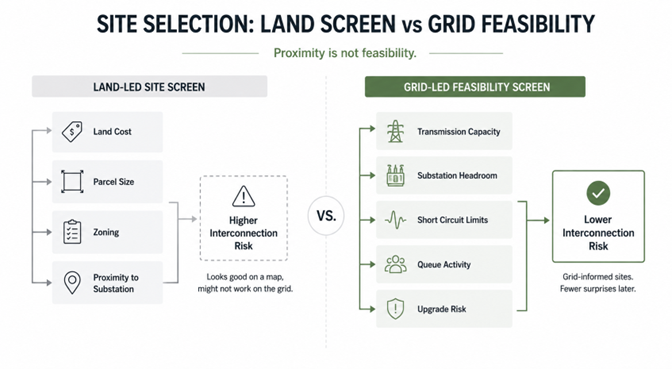
BESS creates a different grid planning problem
Battery storage does not behave like traditional generation. A BESS project can charge, discharge, switch operating modes, and respond to system conditions through inverter controls. The grid sees the asset differently depending on dispatch, control settings, state of charge, and local system strength. That creates several study questions:- Can the proposed point of interconnection support charging and discharging under credible system conditions?
- Does the site create thermal or voltage constraints during peak dispatch?
- Are fault levels within equipment and protection limits?
- Will the BESS contribute enough fault current for protection schemes to operate correctly?
- Could inverter controls interact with nearby renewable generation or other storage projects?
- Does future queue activity change upgrade exposure?
The real cost is late discovery
Late grid discovery creates expensive choices. A developer may secure land, commit to an interconnection filing, begin commercial discussions, and then discover that the project requires material upgrades. At that point, every option is harder. The project can downsize, redesign, move, accept higher upgrade costs, or withdraw. None of those choices is attractive. Early feasibility work gives the project team more control. It allows developers to compare sites before momentum builds. It helps identify which substations have better headroom, which constraints are manageable, and which risks could affect schedule or cost. In PowerTek’s early-stage work with storage and renewable developers, the most useful decision is often not a final engineering answer. It is a ranked view of site risk. A developer can compare two or three candidate locations based on grid capacity, interconnection complexity, expected study exposure, and the likelihood of future constraints. That kind of screening changes the conversation. The project is no longer asking, “Can this parcel work?” It is asking, “Which site gives the project the best chance to survive interconnection?”What a strong BESS grid feasibility study should cover
A useful feasibility study connects engineering analysis to development decisions. For a BESS project, that usually includes:- transmission and substation capacity review
- point of interconnection screening
- load flow and thermal constraint analysis
- voltage performance review
- short circuit and fault level assessment
- protection and breaker duty considerations
- review of nearby queue activity and future system pressure
- preliminary interconnection risk ranking
- expansion visibility for future project phases