
Speed to Power Is a Reliability Test
Why data centers, AI infrastructure, and large-load projects need early grid analysis before service dates become promises
Everyone wants faster power.
Data center developers want it. Manufacturers want it. Public agencies want it. Utilities face pressure to deliver it.
But speed-to-power is not only a commercial timeline.
It is a reliability test.
A project can move fast on land, financing, permits, and customer commitments. The grid moves through studies, equipment limits, outage windows, protection settings, upgrade sequencing, and operating rules.
That difference matters.
The winning projects will not simply ask for the earliest service date. They will build a service plan the grid can defend.
Speed-to-power has three clocks
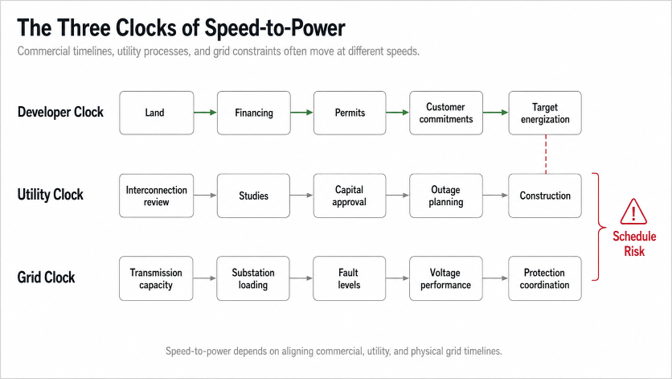
Large-load projects now run on three clocks.
The first clock is the developer clock. It tracks land control, financing, customer demand, procurement, and target energization.
The second clock is the utility clock. It tracks interconnection review, load studies, equipment lead times, outage planning, and capital approvals.
The third clock is the grid clock. It tracks transmission capacity, substation loading, fault levels, voltage performance, protection coordination, and contingency behavior.
Most schedule risk appears when these clocks do not match.
A data center may want 300 MW in 24 months. The local substation may need transformer upgrades. The transmission corridor may show overloads under N-1 conditions. Protection settings may need revision. Breaker duty may require equipment replacement.
The project is not slow because people lack urgency.
It is slow because the system has conditions that cannot be skipped.
Faster service needs better early answers
Speed-to-power improves when engineering starts earlier.
A site screen should not stop at land, fiber, water, tax terms, and nearby transmission. It should test whether the system can support the requested load under real operating conditions.
That means answering technical questions before the project hardens around a date.
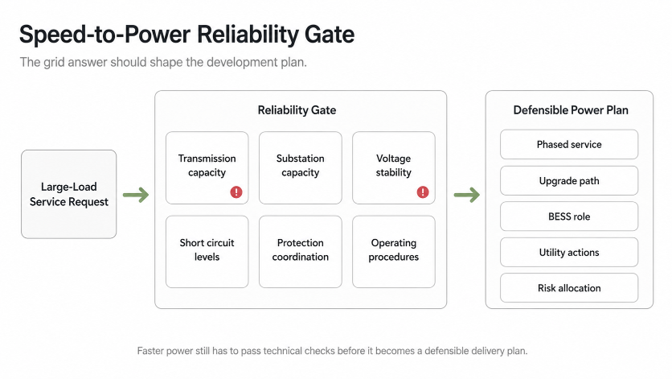
Can the transmission system carry the load? Can the substation handle the capacity? Do short circuit levels stay within equipment ratings? Does voltage performance hold during contingencies? Can relay settings, breaker duties, and operating procedures support the new demand?
PowerTek has seen this issue across utility planning, large-load analysis, interconnection studies, BESS integration, and transmission planning. In confidential U.S. utility master planning through 2050, PowerTek supported planning around future load growth, grid constraints, and upgrade sequencing. That work treated timing as an engineering variable, not only a commercial target.
The grid answer should shape the development plan
A strong speed-to-power strategy starts with what the grid can actually support.
The answer may not be full service on day one. It may be phased service. It may require a different point of interconnection. It may need BESS, backup supply, reactive support, substation upgrades, or transmission reinforcement.
That is not a failure.
It is the difference between an aggressive request and a workable plan.
For AI infrastructure and data center interconnection, the early study should give the project team five decisions:
- Which site carries the lowest grid risk?
- Which service date can the utility defend?
- Which upgrades affect the critical path?
- Which load phases can connect first?
- Which risks need customer, utility, or ratepayer treatment?
These answers turn speed-to-power from a slogan into a plan.
Reliability protects everyone in the process
Fast power has to protect more than the project schedule.
It has to protect grid reliability, utility operations, ratepayers, and long-term planning. A rushed interconnection that creates voltage issues, protection gaps, or unplanned upgrade exposure can shift risk across the system.
That is why utility planning and power systems engineering now sit closer to economic development.
In large-load discussions, PowerTek often focuses on the questions behind the requested megawatts. What does the load do to the surrounding system? What changes after each phase? Which upgrades are unavoidable? Which constraints can be managed through sequencing, controls, BESS, or operating limits?
Those questions matter before commitments become public.
They matter even more after they do.
Defensible power is what gets built
Fast power is valuable.
Defensible power is what gets built.
The projects that move with fewer surprises study the grid before the service date becomes a promise. They test transmission constraints, substation capacity, voltage stability, short circuit levels, protection coordination, and upgrade exposure early.
They also accept a simple truth.
The grid is not a backdrop to development.
It is the test every large-load project must pass.