
Not All Megawatts Behave the Same
Why data center load behavior, dynamic studies, EMT modeling, protection coordination, and power quality now shape grid reliability
A megawatt is not just demand.
It is behavior the grid has to carry.
That distinction matters as AI campuses, hyperscale data centers, BESS projects, renewable plants, and large industrial loads connect to the same transmission and distribution systems.
A 300 MW data center is not only a number in a forecast. It has a load shape. It ramps. It affects voltage. It can introduce power quality issues. It changes fault current assumptions. It interacts with protection schemes, nearby generation, BESS controls, and contingency events.
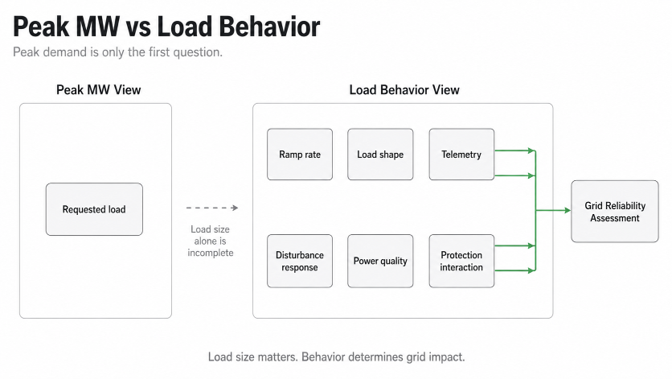
Peak demand tells the utility how large the request is.
Load behavior tells the utility what the system must survive.
Peak demand is only the first question
Large-load planning cannot stop at peak MW.
Two projects can request the same load and create different grid impacts. One may ramp gradually. Another may move in sharper blocks. One may have predictable operating patterns. Another may combine IT load, cooling load, UPS systems, backup generation, and BESS in ways that change system response.
The grid sees those differences.
Transmission planners care about power flow and contingency loading. Protection engineers care about fault current and relay coordination. Operators care about visibility, ramping, and recovery after disturbances. Power quality engineers care about harmonics, flicker, and voltage behavior.
That is why utility planning now needs more than a load number.
It needs a behavior profile.
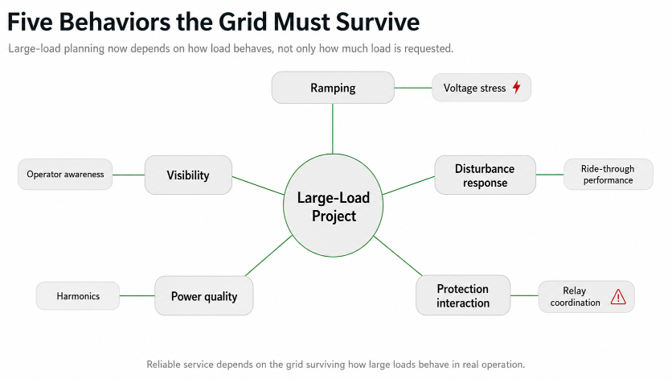
Five behaviors now matter in large-load planning
Large-load studies should test how the project behaves, not only how much it consumes.
The first behavior is ramping. A fast load increase can create voltage stress, operating concerns, or reserve needs. That matters for AI campuses and data centers with phased energization.
The second behavior is visibility. Operators need telemetry that shows what the load is doing. Poor visibility turns a large customer into a planning assumption.
The third behavior is disturbance response. The system must know how the load responds during voltage dips, faults, switching events, and transmission outages.
The fourth behavior is power quality. UPS systems, power electronics, and large motor loads can affect harmonics, flicker, and waveform distortion.
The fifth behavior is protection interaction. Fault levels, relay settings, breaker duties, and coordination margins can change after a large load connects.
These are not academic questions.
They decide whether the system can serve the project reliably.
Steady-state studies are necessary, not sufficient
Steady-state analysis gives the starting answer.
It shows whether thermal loading, voltage levels, and base-case flows remain within limits. That matters. It does not fully answer how the system performs after a disturbance.
Dynamic stability studies, PSCAD studies, EMT modeling, short circuit analysis, protection coordination, and power quality studies answer the next layer of questions.
How does voltage recover after a fault? Do controls interact in unexpected ways? Does the load ride through a disturbance or trip in a way that worsens the event? Do protection devices operate in the right sequence?
PowerTek applies this logic in BESS, renewable integration, and large-load work. In BESS lifecycle work for IESO and BESS and microgrid owner’s engineering for Qulliq Energy Corporation, PowerTek evaluated operating behavior, system integration, and performance requirements beyond nameplate capacity. Those same questions now apply to AI infrastructure and hyperscale data centers.
A project’s rating tells one story.
Its behavior tells the one the grid has to manage.
Behavior changes planning decisions
Load behavior affects capital planning, interconnection strategy, and operating requirements.
A gradual ramp may support phased service. A sharper ramp may require system upgrades, controls, or operating limits. A load with poor ride-through behavior may need additional study before full energization. A facility with power quality risk may need filtering, monitoring, or equipment changes.
These decisions belong early in development.
Late discovery creates hard choices. Site plans may need revision. Service dates may shift. Protection settings may change. Commissioning requirements may expand. Utility operating procedures may need updates.
Early behavior analysis gives the project team more room to act.
It helps utilities define study requirements. It helps developers compare sites and phasing options. It helps EPCs design around real system conditions. It helps large-load customers understand what the grid needs before full service is requested.
The grid must survive the load, not just serve it
The market talks about AI load in megawatts.
Utilities study it as system behavior.
That difference will shape data center interconnection, transmission planning, grid modernization, power quality requirements, and utility engineering for large loads.
The better question is not only: how many megawatts are coming?
The better question is: how will those megawatts behave when the system is under stress?
A megawatt is not just demand.
It is behavior the grid has to survive.