
America Does Not Have an AI Problem. It Has a Power Problem.
Why AI infrastructure, data centers, transmission planning, and grid modernization now decide where growth can happen
America does not have an AI problem.
It has a power problem.
For the last two years, the public conversation has focused on chips, models, and data centers. Capital is moving into AI infrastructure. New campuses are being planned. Large users are searching for sites with land, fiber, water, and power.
Power is becoming the constraint.
Not servers. Not land. Not financing.
Power.
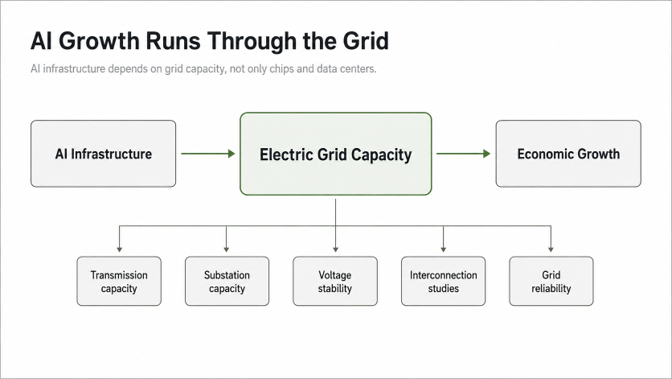
AI growth now depends on grid capacity
AI infrastructure cannot scale without electricity.
A single hyperscale data center campus can require 100 MW, 300 MW, or more. At that size, the project no longer behaves like a normal customer. It changes transmission flows, voltage needs, fault levels, and regional planning assumptions.
That changes the development question.
The question is no longer only, “Can the utility serve the load?”
The better question is, “What does this load do to the grid?”
That is why large-load grid analysis now belongs at the start of AI infrastructure planning. It should not wait until site control, equipment plans, and commercial timelines are already fixed.
The grid was built for a different load profile
Much of America’s grid was planned around slower change.
Load growth followed more predictable patterns. Generation was more centralized. Transmission planning had longer cycles. Major system changes had more time to move through studies, approvals, and construction.
AI demand does not move that slowly.
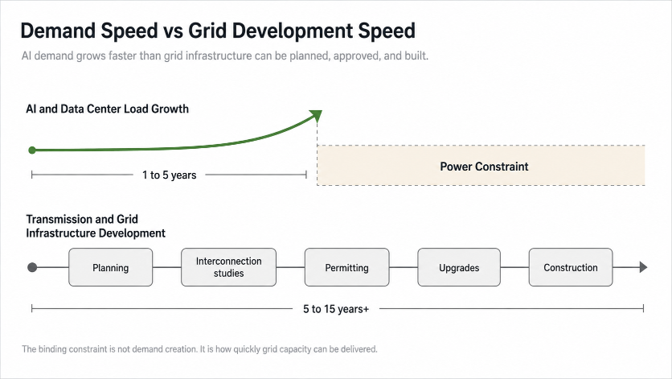
Data centers can create large step changes in load. Semiconductor plants and advanced manufacturing add new industrial demand. Electrification increases baseline load across transportation, buildings, and industry. Renewable generation adds supply, but often far from the load centers that need it.
That creates a timing problem.
Demand can arrive in a few years. Transmission projects can take many years to plan, permit, approve, and build.
The gap between those timelines now affects where AI infrastructure can be built.
Generation alone will not solve the problem
More generation helps, but it does not solve grid constraints by itself.
Power still needs a path from generation to load. That path runs through substations, transmission corridors, protection systems, voltage support, and interconnection processes.
A region may have generation under development and still lack deliverable capacity. A site may sit near a substation and still face thermal constraints. A campus may secure a power commitment and still require upgrades before full load can be served.
These are power system issues.
They require transmission planning, interconnection studies, load flow analysis, voltage stability review, short circuit analysis, protection coordination, and dynamic system studies.
PowerTek sees this in utility planning and large-load work. In a project for a major client in Ohio large-load analysis, PowerTek supported planning around new demand and system capability. In PJM, PowerTek supported more than 400 generation interconnection studies representing roughly 130 GW of proposed projects.
Those examples point to the same lesson.
Capacity on paper is not the same as grid readiness.
AI infrastructure turns electricity into a strategy question
Power availability now affects economic competitiveness.
Regions with available grid capacity can attract data centers, manufacturing, BESS projects, and supporting infrastructure. Regions with constrained systems face longer timelines, higher upgrade exposure, and fewer site options.
That makes grid modernization a business issue.
Utilities need better visibility into load growth, transmission constraints, and system impacts. Developers need earlier answers on interconnection risk. Large energy users need clarity on when capacity can be served, not just whether it exists in theory.
The strongest projects answer these questions early.
They test the grid before land, equipment, and financing assumptions become fixed. They compare points of interconnection. They study phased load growth. They identify transmission, voltage, protection, and stability issues before those issues become schedule risks.
The next decade will be defined by who can power what they build
The technology exists.
The capital exists.
The constraint is whether power infrastructure can keep pace.
AI leadership will not depend only on models or chips. It will depend on the regions that can deliver reliable electricity at scale. It will depend on transmission planning, grid modernization, interconnection reform, BESS integration, and power system studies that turn demand growth into practical infrastructure plans.
America’s grid is no longer background infrastructure.
It is now part of national capability.
The next decade will not be defined only by who wants to build.
It will be defined by who can power what they build.