
Behind-the-Meter Power Does Not Eliminate Grid Risk
Why data centers with co-located generation, BESS, and backup supply still need interconnection studies and grid interface analysis
A data center with co-located generation is not automatically off-grid.
It may have gas generation. It may have solar. It may have BESS. It may have backup supply. It may reduce some grid exposure.
But the engineering question does not disappear.
It moves to the interface.
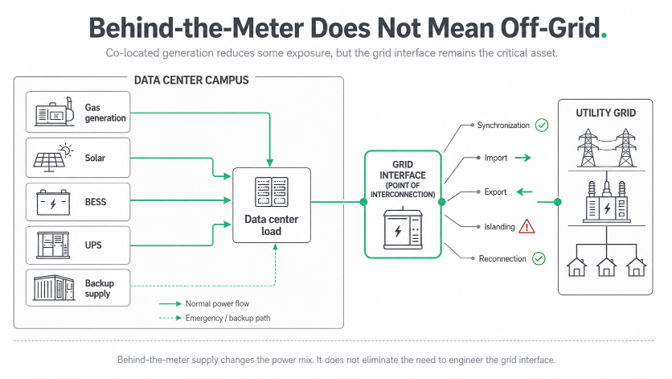
That interface determines how the site synchronizes, imports, exports, islands, reconnects, clears faults, and coordinates with the utility system.
Private power does not remove the grid from the equation.
It makes the grid connection more important.
The grid interface becomes the critical asset
Behind-the-meter power changes the project, but it does not erase utility requirements.
A data center with on-site generation still needs clear answers to practical questions. How does the site synchronize with the grid? What happens when generation trips? Can the system island safely? Does the site ever export power? What import level is required during maintenance or outage conditions?
Each answer affects design.
Protection settings may change. Breaker duty may change. Voltage performance may change. Operating agreements may need tighter rules. BESS controls may need study under faults, switching events, and grid disturbances.
A behind-the-meter strategy can reduce exposure to grid constraints.
It can also create new operating risk if the interface is not studied early.
Co-located generation creates different failure modes
A fixed utility supply has one risk profile.
A site with gas generation, solar, BESS, UPS systems, backup supply, and grid import has another.
The system must manage transitions between operating modes. It may run grid-connected, islanded, partially supplied by BESS, supported by gas generation, or importing from the utility during equipment outages.
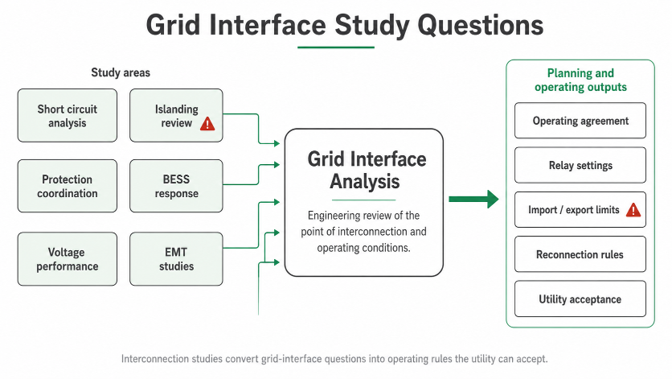
Those modes create study questions:
- Can the site island without destabilizing internal loads?
- Can it reconnect without creating voltage or frequency issues?
- Do relays coordinate during grid-connected and islanded operation?
- Does BESS support the site during disturbances?
- Does the site export power under any operating condition?
- Does generation tripping create a sudden import requirement?
- Do harmonic or transient issues appear during switching?
These are not paperwork items.
They define whether the facility can operate as planned.
Interconnection studies still matter
Co-located power is not a shortcut around interconnection.
It often expands the interconnection study scope.
A utility still needs to know how the site behaves at the point of interconnection. Short circuit analysis must test fault contribution from utility and site sources. Protection coordination must confirm selectivity. Voltage studies must test import, export, and transition conditions. Dynamic studies or EMT studies may be needed for inverter-based resources and BESS controls.
PowerTek sees this issue in hyperscaler, BESS, and off-grid advisory work. In confidential U.S. and Saudi Arabia advisory engagements, PowerTek reviewed BESS and off-grid supply strategies for large-load infrastructure. The question was not only how much power the site could produce. It was how the full system would behave when grid conditions changed.
That is the part many behind-the-meter plans underestimate.
The asset plan may look strong.
The operating sequence may still need work.
Islanding must be designed, not assumed
Islanding is not simply disconnecting from the grid.
A safe islanded system needs defined load blocks, generation controls, BESS response, protection settings, grounding strategy, black start logic, and reconnection procedures.
The utility also needs confidence that the site will not energize lines unintentionally. Anti-islanding protection, transfer trip schemes, relay settings, and operating agreements may all matter.
PowerTek’s owner’s engineering work for Qulliq Energy Corporation on BESS and renewable microgrids dealt with this kind of operating discipline. In diesel-reliant communities, storage and renewable systems had to support reliability, commissioning, controls, SCADA validation, and operational readiness.
The setting differs from an AI data center.
The lesson carries over.
Islanded operation only has value when the system can perform predictably.
BESS can help, but controls decide the result
BESS can improve a behind-the-meter power strategy.
It can support backup supply, manage peaks, smooth generation changes, and help with transition events. It can also complicate protection, fault response, charging behavior, and control interactions.
The grid does not credit BESS because it is installed.
It credits BESS when its operating role is defined and tested.
For a data center, that means studying how BESS responds during faults, voltage dips, generator trips, grid outages, and reconnection events. It also means confirming whether BESS charging creates new import peaks or local constraints.
Battery storage should be treated as part of the power system.
Not as a label on a one-line diagram.
The market sees private power. Utilities see operating risk.
Co-located generation can be a strong strategy for AI infrastructure and large-load development.
It can improve resilience. It can support phased growth. It can reduce exposure to utility capacity constraints. It can help projects move where grid capacity alone is not enough.
But private power does not eliminate engineering risk.
It changes the questions that must be answered.
The project still needs interconnection studies, short circuit analysis, protection coordination, voltage performance review, dynamic stability analysis, EMT studies where needed, BESS studies, and operating agreements.
The market may treat behind-the-meter supply as an escape from the grid.
Utilities know better.
Behind-the-meter power makes the grid interface the most important part of the design.