
Grid-Ready Siting Is Becoming the New Data Center Advantage
Why AI infrastructure site selection now depends on power availability, interconnection risk, transmission planning, and substation capacity
The best data center site is not always the cheapest land.
It is the site the grid can actually serve.
That shift is changing data center development. Land still matters. Fiber still matters. Water, permitting, tax incentives, and local support still matter.
But none of those inputs can rescue a weak power path.
A site can look perfect on a map and still fail the grid test. The local substation may have no headroom. The nearby transmission line may face contingency constraints. Transformer lead times may miss the commercial schedule. Breaker duty, voltage performance, or protection changes may add cost and delay.
Grid-ready siting starts with a different question.
Not: “Is power nearby?”
The better question is: “Can this system serve the campus, at this scale, on this timeline?”
Cheap land can become expensive power
Land cost is visible early.
Grid cost often appears late.
That timing creates risk. A developer may secure a parcel, advance permits, build a financing case, and set customer expectations before the utility study reveals the real power path.
At that point, the project has fewer choices.
A constrained substation can force a new point of interconnection. Limited transmission capacity can require phased service. Transformer delays can affect energization. Voltage concerns can add reactive power needs. Protection coordination can change equipment and commissioning requirements.
The land may still be cheap.
The project may no longer be.
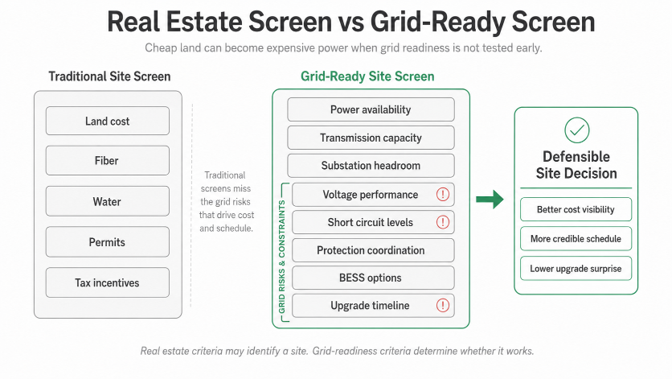
Grid-ready siting needs engineering before land control
A credible data center site screen should test the grid before commitments harden.
That screen should review power availability, interconnection risk, transmission constraints, substation capacity, short circuit levels, voltage performance, protection coordination, BESS options, and upgrade exposure.
It should also test phasing.
A site that cannot serve 500 MW on day one may still support 100 MW first, then expand after upgrades. Another site may support the first block but fail on future growth. A third site may carry lower land value but a cleaner power path.
The best answer is not always the site with the lowest cost.
It is the site with the most defensible path to service.
The power path decides the schedule
Speed-to-market starts before the interconnection request.
A developer that studies power early can compare sites, test points of interconnection, review utility upgrade risk, and shape a phased service plan. A developer that waits may discover the grid answer after the commercial plan is already built.
That difference affects the schedule.
PowerTek often works at the front end of development. In confidential U.S. and Saudi Arabia hyperscaler advisory work, PowerTek reviewed BESS and off-grid supply strategies for large-load infrastructure. The core question was not only how to produce power. It was how the site would interact with the utility system under real conditions.
That same logic applies to site selection.
A data center does not only need power. It needs a power path the utility can study, approve, build, and operate.
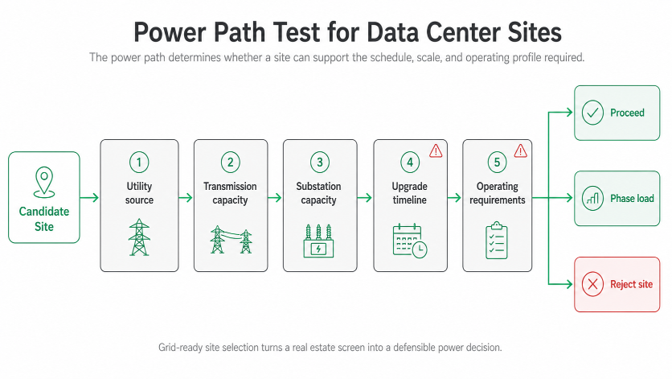
BESS and backup supply can help, but only if the grid accepts the plan
BESS can improve a site strategy.
It can reduce peak exposure, support phased service, improve backup strategy, and add operating flexibility. Gas generation or other backup supply can also support resilience and reduce some grid dependence.
Those assets do not erase interconnection risk.
They change the study questions.
How will BESS charge during constrained hours? Does backup generation ever parallel with the grid? Can the site island safely? What happens during a fault? Does the site export power? Do protection settings coordinate across operating modes?
A grid-ready site answers those questions early.
It does not treat BESS or backup supply as a shortcut around utility review.
The winning site is the one the system can defend
Data center site selection is moving from real estate screening to infrastructure diligence.
The market still values land, fiber, incentives, and speed. Utilities evaluate transmission capacity, substation headroom, voltage stability, breaker duty, protection coordination, outage windows, and upgrade sequencing.
Both views matter.
The winning site is where they meet.
For AI infrastructure, the real advantage may not be the parcel with the lowest land cost. It may be the location with the clearest power path, the fewest upgrade surprises, and the strongest case for phased growth.
The best site is not where power appears nearby.
It is where the grid can serve the campus without breaking the project’s cost, schedule, or reliability assumptions.