
Deliverable Capacity Is Becoming the New Currency of Grid Planning
Why data centers, industrial loads, BESS, and utility capital plans depend on serviceable megawatts, not requested megawatts
The most important number in a large-load project is not the requested load.
It is the deliverable load.
That difference is starting to shape data center development, industrial electrification, renewable integration, BESS planning, and utility capital investment.
A developer may request 200 MW, 500 MW, or more. The headline number gets attention. The grid answers a different question.
What can the system actually serve at that location, in that timeframe, under credible operating conditions?
That is deliverable capacity.
Requested load is a commercial number
A load request tells the market what a project wants.
It does not prove what the grid can serve.
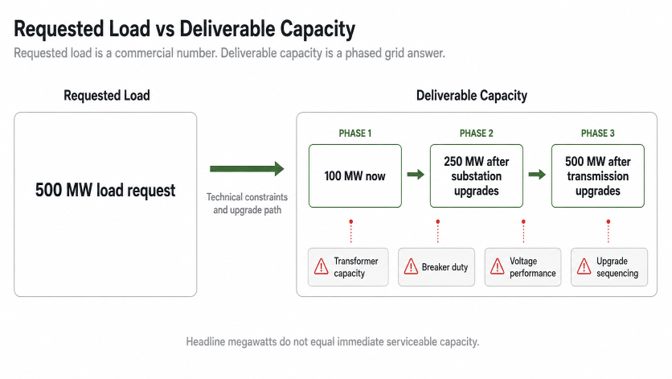
A site may have strong land control, customer demand, financing, and economic development support. It may still face transmission constraints, substation limits, transformer availability issues, breaker duty concerns, voltage performance gaps, or upgrade sequencing delays.
Those constraints change the real capacity profile.
A 500 MW request may become 100 MW in the first phase, 250 MW after substation work, and 500 MW after transmission upgrades. The project still wants 500 MW. The grid may deliver it over time, not all at once.
That difference affects financing, site selection, customer commitments, and utility planning.
Deliverable capacity depends on conditions
Deliverable capacity is not a single number.
It depends on system conditions.
Transmission capacity matters. Substation capacity matters. Transformer availability matters. Short circuit levels matter. Protection coordination matters. Voltage stability matters. Outage windows, construction timing, and equipment lead times matter.
The credibility of the load also matters.
Is the site controlled? Is the project phased? Is financing aligned with the service date? Is there a realistic backup supply plan? Can BESS reduce peak exposure or improve operating flexibility? Can the customer accept staged energization?
These questions change how utilities plan and how developers should screen sites.
Utilities now plan for credibility and capability
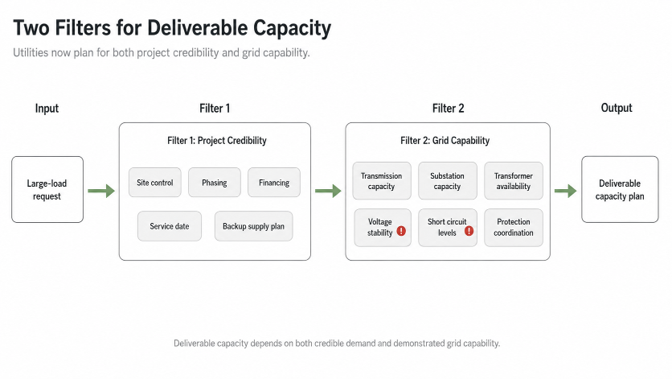
Large-load planning now needs two filters.
The first filter is project credibility. Utilities need to know which load requests are likely to materialize, when they will arrive, and how they will ramp.
The second filter is grid capability. Planners need to know what the system can serve without violating thermal, voltage, short circuit, protection, or contingency limits.
Both filters must work together.
A credible project in a constrained location may need major upgrades. A technically strong location may still carry commercial uncertainty. A capital plan that ignores either filter can misplace investment.
POWER-tek USA LLC applies this logic across utility planning, BESS integration, interconnection studies, and large-load analysis. In confidential U.S. utility master planning through 2050, PowerTek supported planning around future load growth, grid constraints, and investment sequencing. In IESO BESS lifecycle support and Qulliq Energy Corporation owner’s engineering for BESS and renewable microgrids, the same question appeared in a different form: what can the system support under real operating conditions?
The answer was not just nameplate capacity.
It was deliverable capability.
BESS can improve flexibility, but it must be studied
BESS can change the deliverable capacity discussion.
Battery storage can support peak management, backup strategy, staged service, voltage support, and operating flexibility. It can also add charging demand, inverter controls, protection questions, and dynamic behavior that the system must study.
A BESS is not automatically a solution.
It becomes useful when its operating role matches the grid constraint.
For a data center, BESS may reduce peak exposure or support backup supply. For a utility, it may defer a capital upgrade or support local reliability. For a renewable project, it may improve dispatchability or reduce curtailment.
Each case needs analysis.
The grid does not credit storage because it exists. It credits storage when its behavior supports the system.
Capital will follow deliverable megawatts
The next phase of infrastructure competition will reward regions that can prove serviceable capacity.
Press releases will still announce requested megawatts. Planners will focus on deliverable megawatts.
That shift affects where data centers locate, where manufacturing expands, where utilities invest, and where BESS creates practical system value.
It also affects risk allocation.
If a region can serve 100 MW now and 500 MW after upgrades, every stakeholder needs to know that early. Developers need it for phasing. Utilities need it for capital planning. Public agencies need it for economic development commitments. Customers need it for realistic service dates.
The grid is pricing reality
The market talks about announced demand. The grid prices deliverability.
That price shows up through upgrade costs, service timelines, phased capacity, operating limits, and interconnection requirements.
The projects that move better will not be the ones with the largest requests. They will be the ones that match load ambition with system capability.
The headline number starts the conversation. Deliverable capacity decides what gets built.