
Data Centers Are Changing Utility Planning Forever
Why AI infrastructure, large-load interconnection, transmission planning, and grid modernization now require a new planning model
Utilities used to forecast demand.
Now they are forecasting ambition.
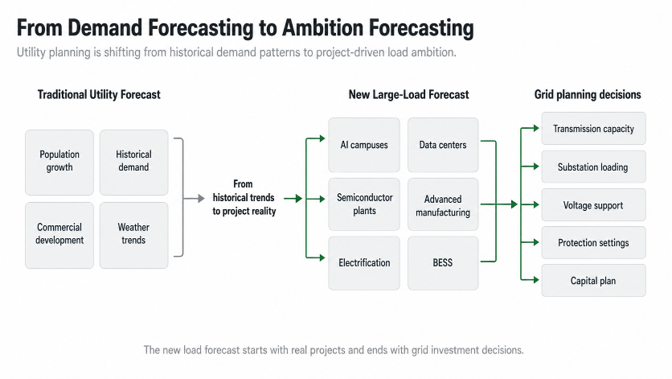
For decades, load forecasting relied on a familiar pattern. Population growth, commercial development, industrial activity, and historical demand gave planners a stable base. Forecasts were not perfect, but the range of outcomes was usually manageable.
That planning model no longer fits the demand now arriving at utilities.
A single hyperscale data center, AI campus, semiconductor facility, or advanced manufacturing plant can add hundreds of megawatts to a region. That one project can change transmission loading, substation capacity, voltage support, short circuit levels, protection settings, and long-term capital plans.
The forecast is no longer only about expected demand.
It is about which growth projects will materialize, when they will arrive, and whether the grid can support them.
The new load forecast starts with project reality
Large-load planning now depends on the quality of project evidence.
A utility cannot treat every proposed AI campus or manufacturing facility as firm load. Many projects will shift, resize, delay, or withdraw. At the same time, utilities cannot ignore them. One real project can consume years of available capacity in a local area.
That creates a planning challenge.
Utilities need to separate speculative demand from credible demand. Site control, phasing plans, utility service requests, customer timelines, financing status, and interconnection readiness all matter. So does the engineering answer: can the grid serve the load at the requested location?
PowerTek sees this issue in utility planning and large-load analysis. In confidential U.S utility master planning through 2050, PowerTek supported long-range infrastructure planning where future load growth, grid constraints, and investment sequencing had to align. The planning question was not just how much demand might appear. It was where the system would reach its limits first.
Data centers change the grid before they connect
A large data center affects planning before energization.
A 100 MW or 500 MW load can force a utility to revisit transmission assumptions, substation loading, breaker duty, voltage performance, and contingency plans. The project can also change how nearby generation, BESS, and other industrial loads fit into the same network.
This is why utility planning now intersects with large-load interconnection studies.
A standard forecast may show regional demand growth. A grid impact study shows where that demand stresses the system. The difference matters. One tells the utility demand is coming. The other shows what the grid must change to serve it.
PowerTek often works at that intersection: load forecast, system model, interconnection pathway, and upgrade exposure. The practical output is a planning view that shows what the system can support now, what changes at the next load block, and what investment decisions cannot wait.
The old planning cycle is too slow for AI demand
AI infrastructure moves faster than traditional grid planning.
A data center developer can select a region, negotiate land, and target service dates while the utility still needs to study transmission impacts, substation constraints, protection changes, and upgrade schedules. That timing gap creates risk on both sides.
For utilities, the risk is underbuilding or misplacing capital.
For developers, the risk is committing to a site before the grid answer is clear.
For public agencies, the risk is approving economic development plans that assume power will arrive on time.
This is why scenario planning has become a core utility planning tool. Utilities need base, high-growth, and delayed-growth cases. They also need location-specific studies for load pockets tied to data centers, AI infrastructure, advanced manufacturing, hydrogen, and EV supply chains.
Better planning now requires three views of the same system
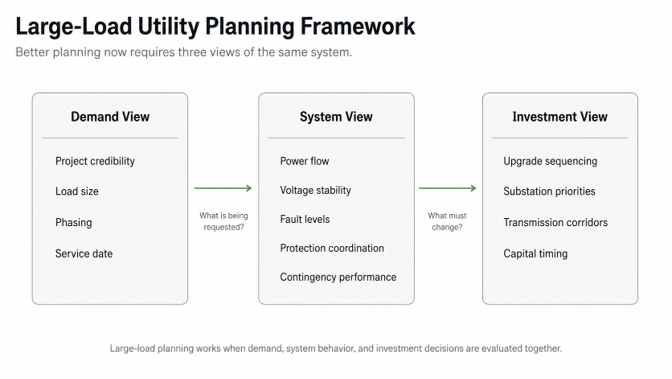
Utility planning now needs three connected views.
First, planners need a demand view. Which projects are credible? What size? What phase? What service date? What load shape?
Second, engineers need a system view. What happens to power flow, voltage stability, fault levels, protection coordination, and contingency performance?
Third, leadership needs an investment view. Which upgrades protect the most optionality? Which substations limit growth? Which transmission corridors need attention first? Which projects can wait?
Those views must connect.
A demand forecast without engineering support can create false confidence. A system study without project context can miss the timing risk. A capital plan without scenario analysis can overbuild one area and underbuild another.
PowerTek’s work in transmission planning, interconnection studies, BESS integration, and grid modernization focuses on connecting those views. The goal is practical: turn uncertain growth into planning decisions that utilities can defend.
Data centers are changing what utilities must plan for
Utilities no longer plan only for load growth.
They plan for load volatility, site competition, phased demand, customer concentration, and grid constraints that can move economic development from one region to another.
That changes the planning standard.
A utility master plan now needs to test where growth may happen next, not just where growth happened before. It needs to identify the substations, transmission corridors, and protection schemes that will limit large-load service. It needs to show which investments create room for data centers, manufacturing, renewable energy, and BESS without weakening reliability.
The future grid will not be built around yesterday’s demand pattern.
It will be built around the locations where growth can actually be served.
Utilities used to forecast demand.
Now they must forecast ambition, test it against the grid, and decide which parts of the system need to move first.