
Grid Capacity Maps Are Not Interconnection Answers
Why hosting capacity, substation capacity, and system studies matter before site selection becomes a commitment
The biggest mistake in early project development is confusing available grid capacity with available interconnection capacity.
A grid capacity map can show where infrastructure appears available.
It cannot prove a project can connect.
That distinction matters for data centers, BESS projects, renewable energy, advanced manufacturing facilities, and large industrial loads. A site may look strong on a map because it sits near transmission, a substation, or a region with available capacity. The formal study process may later show a different answer.
A 200 MW data center can change transmission flows. A BESS project can create charging constraints. A solar project can affect voltage performance. A nearby substation can lack transformer capacity, breaker duty, or protection headroom.
The map starts the conversation.
The system study determines the answer.
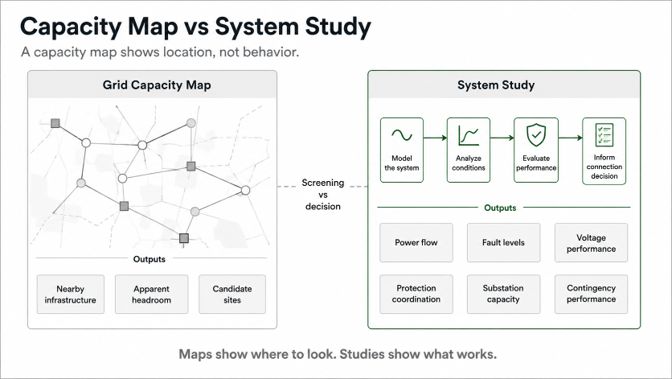
A capacity map shows location, not behavior
A hosting capacity map is a screening tool.
It can help developers find regions with apparent headroom, nearby substations, and transmission access. It can also help utilities communicate where growth may be easier to study.
It does not show how the system will behave after the project connects.
A capacity map cannot test N-1 contingency performance. It cannot show whether fault levels remain within equipment ratings. It cannot confirm relay coordination. It cannot determine whether voltage recovery holds after a disturbance. It cannot predict future queue activity at the same interconnection point.
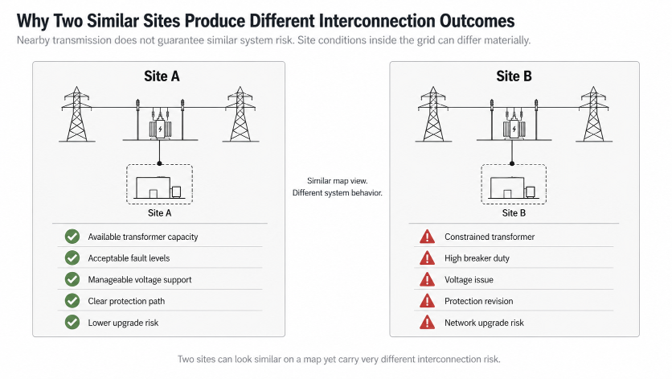
That is why two sites can look similar on a map and produce different interconnection outcomes.
One site may require limited upgrades. Another may trigger substation work, network upgrades, protection revisions, or a different phasing plan.
Interconnection capacity depends on the whole system
Available interconnection capacity depends on more than spare megawatts.
It depends on how the project changes the network around it.
A proper interconnection planning review should test:
- power flow and thermal loading
- substation transformer capacity
- short circuit levels and breaker duty
- voltage performance and reactive power needs
- protection coordination
- dynamic stability, where required
- nearby queue activity
- future load and generation scenarios
These study areas answer different questions.
Transmission planning shows whether the network can move power. Substation analysis shows whether the local equipment can support the connection. Short circuit analysis shows whether fault levels stay within equipment limits. Protection coordination shows whether the system clears faults correctly.
A map cannot answer those questions.
A model can.
Developers lose options when engineering starts late
Late engineering findings create expensive choices.
A developer may secure land, sign commercial agreements, build a financing model, and prepare utility filings before real grid constraints appear. At that point, every fix carries more cost.
A constrained substation can change the point of interconnection. A breaker duty issue can affect equipment selection. A voltage constraint can require reactive support. A transmission overload can change the project size, phasing, or schedule.
Early engineering gives the project more room to adjust.
PowerTek sees this pattern across utility planning, interconnection studies, and large-load work. The lesson is consistent.
The strongest projects do not wait for the formal study to reveal basic grid risk.
They test the system before site assumptions harden.
A better site screen combines map data and system analysis
A strong early site screen should combine commercial inputs with engineering evidence.
Land, zoning, fiber, water, tax structure, and development timeline still matter. They are not enough.
The grid screen should rank each site by interconnection risk. It should compare point of interconnection options. It should identify substation constraints. It should test likely upgrade exposure. It should flag assumptions that require utility confirmation.
For BESS projects, the screen should test charging and discharging behavior. For data centers, it should test phased load growth. For renewable energy projects, it should test deliverability, voltage support, and reactive power needs.
The output should be practical.
Which site should advance? Which site needs more study? Which site should stop before more capital goes in?
The question is not whether capacity appears to exist
Grid capacity maps have value.
They help start the search. They help narrow regions. They help teams ask better questions.
They do not replace grid impact analysis, interconnection studies, transmission planning, substation review, or system modeling.
That distinction now matters more because projects are larger, faster, and more grid dependent. Data centers, AI infrastructure, BESS, renewable energy, and industrial loads can change the system around them.
The real question is not whether capacity appears to exist.
The question is whether the grid can actually support the project.