
Large-Load Interconnection Is a System Test
Why data centers, AI campuses, manufacturing plants, and industrial loads need grid impact analysis before utility filings begin
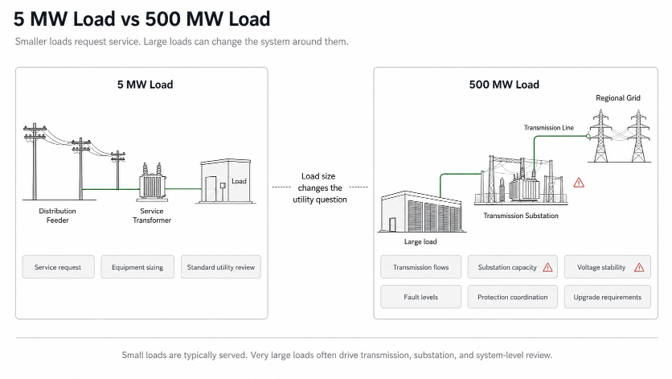
A 5 MW load asks the utility for service.
A 500 MW load asks the utility to rethink part of the system.
That is the difference many large-load projects underestimate.
Data centers, AI campuses, semiconductor plants, hydrogen facilities, EV factories, and advanced manufacturing sites do not behave like traditional commercial loads. At this scale, the utility does not only ask whether power is nearby.
It asks what the load does to the grid.
Large loads change the grid around them
A large-load interconnection can affect the system before the first breaker closes.
A 100 MW, 300 MW, or 500 MW project can change transmission flows, substation loading, voltage performance, fault levels, and protection requirements. It can also affect regional planning assumptions if the load arrives faster than prior forecasts assumed.
That creates a different development problem.
A site can have land, fiber, water, tax support, and nearby infrastructure. It can still fail the grid test.
The local substation may lack transformer capacity. The transmission corridor may face contingency overloads. Fault levels may exceed breaker ratings. Voltage recovery may require reactive support. Protection schemes may need revision before the project can connect.
These are not administrative issues.
They are system questions.
The utility process starts too late for many projects
The formal utility application gives a project an official answer.
It rarely gives the earliest useful answer.
By the time a large-load project enters the formal process, major assumptions may already be set. Site teams have advanced land control. Commercial teams have promised capacity. Equipment planning has started. Financing models include energization dates.
Late grid findings reduce flexibility.
A constrained substation can change the interconnection plan. A transmission upgrade can change schedule. A short circuit issue can change equipment selection. A voltage stability issue can change system architecture.
PowerTek sees this pattern in large-load and utility planning work. In Ohio, a large-load analysis study, PowerTek supported planning around new demand and system capability. The work focused on what the system could support, where constraints could appear, and how planning decisions should account for future load.
The useful question came before the application.
Can the system actually serve the load?
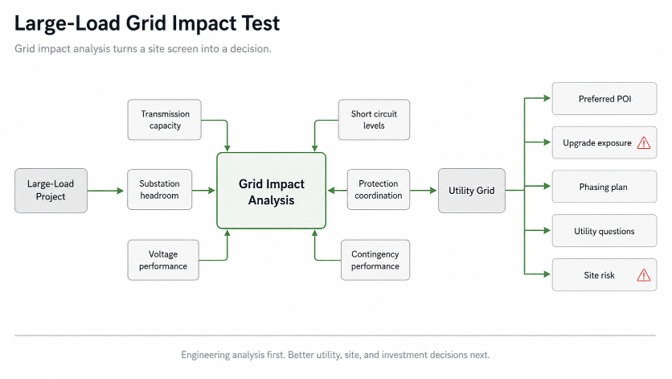
Grid impact analysis turns a site screen into a decision
A map-based site screen is not enough for large-load development.
Proximity to a substation or transmission line does not prove capacity. It only proves location. A proper grid impact analysis tests the network around the site before commitments harden.
For a large-load interconnection, the early study should test:
- transmission capacity and thermal loading
- substation transformer capacity
- voltage performance and reactive power needs
- short circuit levels and breaker duty
- protection coordination at the utility interface
- contingency performance under N-1 conditions
- phased load growth and future expansion
- nearby generation, BESS, and queue activity
The output should not be a generic technical memo.
It should answer development questions. Which point of interconnection carries the lowest risk? What upgrades could affect schedule? How should the load be phased? Which assumptions need utility confirmation? Which site should not advance?
Scale changes who needs to be in the room
Large-load interconnection requires earlier coordination between development, engineering, utility planning, and finance.
The reason is simple. The grid answer can change the business case.
A site that looks attractive commercially may carry a costly network upgrade. A lower-cost parcel may sit behind a constrained substation. A phased energization plan may work better than a full-load request. A nearby BESS or generation project may change the local study outcome.
PowerTek often sees the best results when engineering enters before the commercial path is fixed. The work does not replace the utility process. It prepares the project to enter that process with better questions, better assumptions, and fewer surprises.
In PJM generation interconnection work, PowerTek supported more than 400 studies across roughly 130 GW of proposed projects. The same lesson applies to large loads. Projects move better when they understand system risk before formal study results arrive.
The real test is not nearby power
Large-load interconnection is becoming a constraint on AI infrastructure, data centers, advanced manufacturing, and industrial growth.
The constraint is not always generation. It is often delivery. Transmission capacity, substation headroom, protection limits, voltage support, and upgrade timing decide whether a project can move.
That makes early grid impact analysis part of project diligence.
The question is not only whether power exists in the region.
The better question is whether the system can serve the project, at the requested size, on the required timeline, without changing the economics.
A 5 MW load may ask for service.
A 500 MW load asks the grid to prove it can adapt.