
The Next Grid Bottleneck May Be Inside the Substation
Why substation capacity, breaker duty, protection coordination, and switching complexity now shape project timelines
Everyone is looking at transmission.
The next bottleneck may sit inside the substation fence line.
For the last few years, the industry has focused on generation shortages, transmission expansion, and interconnection queues. Those issues matter. They shape how fast data centers, battery storage projects, renewable generation, and manufacturing facilities can connect.
A different constraint now appears more often.
Substations.
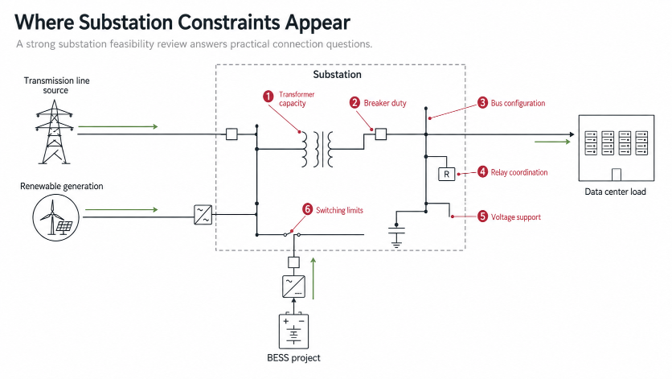
A project can find available generation. It can sit near a transmission corridor. It can appear viable in an early screen. Then the local substation review reveals the harder answer: transformer capacity, breaker duty, bus configuration, protection settings, or switching limits may not support the project without upgrades.
That discovery can change cost, schedule, and interconnection strategy.
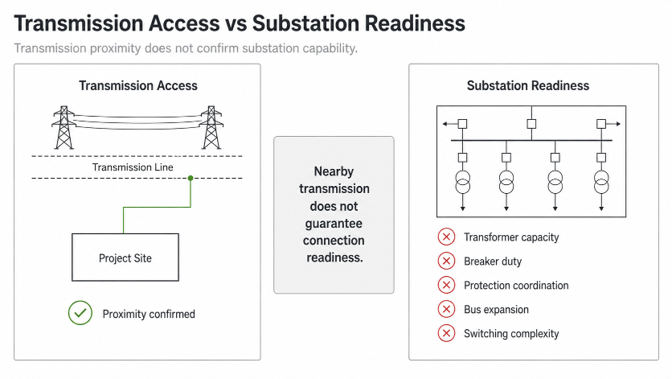
Transmission access does not guarantee substation readiness
A nearby transmission line does not prove the substation can support a new project.
Substations carry their own limits. Transformer capacity may already be committed. Breakers may face higher interrupting duty after a new generator, BESS, or large load connects. Bus layouts may limit expansion options. Protection schemes may need revision. Switching procedures may become more complex under contingency conditions.
These constraints rarely appear in early development headlines.
They appear in interconnection studies, short circuit analysis, protection coordination reviews, and utility planning discussions.
PowerTek sees this issue across large-load and interconnection work. In a Ohio based project for large-load analysis, PowerTek supported planning around new demand and system capability. In PJM interconnection work, PowerTek supported more than 400 generation studies across roughly 130 GW of proposed projects. Point-of-interconnection screening often turned on local equipment limits, not only regional transmission capacity.
Substations now carry more system responsibility
Substations now sit at the intersection of new load, new generation, and grid modernization.
A data center can add 100 MW or more at one location. A BESS project can charge and discharge through the same interconnection point. A renewable project can change fault contribution and voltage support needs. A manufacturing facility can add steady load with strict reliability requirements.
Each project changes what the substation must handle.
That includes:
- transformer loading and spare capacity
- breaker duty and short circuit ratings
- bus configuration and expansion space
- relay settings and protection coordination
- voltage support and reactive power needs
- switching complexity during maintenance and outages
- control interactions with BESS and inverter-based resources
The substation becomes more than a connection point.
It becomes the place where project assumptions meet physical limits.
Late substation findings create expensive choices
Substation constraints become costly when developers find them late.
A project may secure land, file interconnection documents, order equipment, and commit to a schedule before a detailed review identifies required upgrades. At that point, the project team has fewer options.
A transformer upgrade can affect lead time. A breaker duty issue can change equipment specifications. A protection coordination gap can delay energization. A bus expansion issue can force a new interconnection design.
The project may still move forward, but the path changes.
Early engineering analysis gives the project team more control. It can compare interconnection points, test fault levels, review protection schemes, and identify substation limits before commercial assumptions harden.
That matters for data centers, BESS projects, renewable developers, EPCs, and utilities.
A strong substation feasibility review answers practical questions
A useful review does not stop at available megawatts.
It should answer questions that affect development decisions:
- Does the substation have transformer capacity for the proposed project?
- Will the project increase fault levels beyond breaker ratings?
- Do protection schemes still coordinate after the project connects?
- Can the bus configuration support the project and future expansion?
- Does switching complexity create reliability or outage constraints?
- Will voltage support or reactive power needs affect design?
- What upgrades could affect schedule, cost, or phasing?
These answers help developers avoid false confidence. They help utilities identify where growth pressures will land. They help large-load customers understand whether the local infrastructure can support phased expansion.
PowerTek’s work connects these findings to project decisions. The study output should not sit in a technical appendix. It should tell the project team where risk sits, what needs confirmation, and what decisions should happen next.
The overlooked constraint often controls the schedule
The future grid will not be constrained by one type of equipment.
It will be constrained by whichever piece of infrastructure gets overlooked.
Transmission constraints matter. Generation availability matters. Interconnection queues matter. Substation capacity now matters just as much.
For many projects, the limiting factor will not be the transmission corridor nearby.
It will be the transformer, breaker, bus, relay, or switching arrangement inside the fence line.
That is why early substation analysis belongs in the first stage of project development.
The industry conversation often starts with megawatts.
More often now, it ends with infrastructure.