
Grid Modernization Is Not Just An Upgrade Program But A System Redesign
A practical perspective on how utilities are rethinking grid planning, transmission, and interconnection in a changing energy landscape
Grid modernization is often framed as an upgrade program.
In practice, it is a re-architecture of how the system operates.
For decades, power systems were built on a stable foundation. Generation was centralized. Load growth followed predictable patterns. Planning cycles had time to absorb change and translate it into infrastructure.
That foundation has shifted.
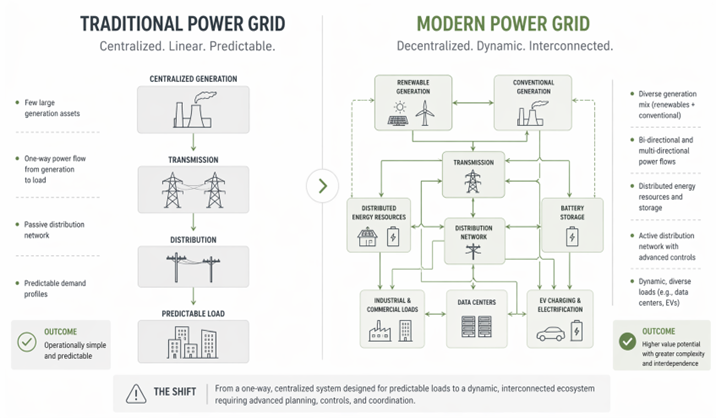
The system is no longer operating under steady assumptions
Utilities today are managing conditions that do not behave the way the grid was originally designed to handle.
The drivers are well understood:
- renewable energy introducing variability into generation
- distributed energy resources changing how power flows locally
- large, concentrated loads such as data centers creating step changes in demand
- electrification increasing baseline load across multiple sectors
Individually, each of these can be managed. Together, they change how the system behaves.
The grid is no longer defined by steady-state operation. It is defined by how it adapts to change.
Modernization is about system behavior, not just new assets
It is tempting to view grid modernization through a technology lens; new substations, advanced controls, digital systems, and upgraded transmission infrastructure.
Those investments are necessary.
They are not sufficient.
Modernization decisions increasingly center on questions such as:
- Where should flexibility sit within the network?
- How should transmission planning adapt to changing power flows?
- What role should storage and distributed resources play in system stability?
- Which constraints require physical expansion, and which can be managed operationally?
These are not equipment decisions. They are system-level decisions.
Without a clear view of system behavior, modernization risks becoming a collection of upgrades rather than a coordinated strategy.
Transmission planning and interconnection are at the center
Two areas are becoming central to grid modernization:
Transmission planning
As renewable energy and large loads reshape power flows, transmission networks are under increasing pressure. Constraints that were previously manageable are becoming binding.
Modern transmission planning requires:
- scenario-based analysis across different load and generation conditions
- identification of constraints before they impact project timelines
- prioritization of investments based on system impact rather than asset age
Grid interconnection
Interconnection is no longer a procedural step. It is a defining factor in project viability.
Developers and utilities must now evaluate:
- available capacity at specific nodes
- system response to new generation or load
- required upgrades and their timelines
The interaction between transmission planning and interconnection analysis is where many modernization decisions are effectively made.
Why a study-driven approach is becoming essential
As system complexity increases, intuition and historical assumptions are no longer sufficient.
Utilities that are progressing effectively in grid modernization are grounding decisions in detailed analysis:
- power flow studies to understand system capacity
- contingency analysis to assess reliability under outage conditions
- dynamic stability studies to evaluate system response under disturbance
- scenario modeling to capture future states that are not yet fully defined
This approach provides clarity on:
- what the system can support today
- how it will behave as conditions evolve
- where investments will have the greatest impact
Without this clarity, modernization efforts risk addressing symptoms rather than root constraints.
The challenge is prioritization and not scale
A common misconception is that grid modernization requires upgrading everything.
In reality, the constraint is not ambition. It is prioritization.
Utilities must decide:
- which transmission corridors are most critical
- where interconnection pressure is highest
- which assets limit system flexibility
- where operational solutions can defer capital investment
The objective is not to modernize the entire system at once. It is to modernize the parts of the system that define overall performance.
This is where disciplined planning creates value.
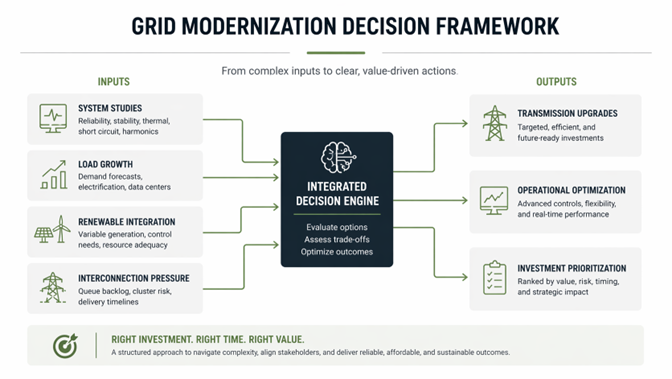
From complexity to actionable decisions
The defining challenge of grid modernization is translating system complexity into decisions that can be executed.
This requires:
- integrating planning, engineering, and operational perspectives
- aligning technical analysis with regulatory and commercial realities
- sequencing investments to match demand timelines
- ensuring that solutions remain viable as conditions continue to evolve
In practice, the difference between effective and ineffective modernization is not the quality of individual projects. It is how well they fit together as part of a system strategy.
PowerTek supports utilities and developers through grid modernization, transmission planning, interconnection analysis, and power system studies.
The focus is on:
- understanding how the system behaves under real and future conditions
- identifying constraints that are not immediately visible
- prioritizing investments based on system impact
- translating technical analysis into practical, implementable strategies
This approach helps move modernization from concept to execution.
Modernization should not be visible
When grid modernization is effective, it does not present as a series of projects.
It shows up as a system that continues to perform as expectations change.
Capacity is available where needed. Constraints are managed before they become limiting. New generation and load integrate without destabilizing the network.
In that sense, modernization is not measured by what is built.
It is measured by how well the system continues to operate.