
Protection Coordination Is What Determines Whether a Fault Stays Local or Becomes a System Problem
A practical perspective on relay coordination, fault isolation, and why modern grids require a different approach to protection engineering
Protection only gets noticed when it doesn’t work. In most projects, protection coordination sits in the background. The system is designed, equipment is specified, studies are completed, and relay settings are configured somewhere along the way. It feels procedural. Until a fault occurs.Faults are inevitable. Outcomes are not.
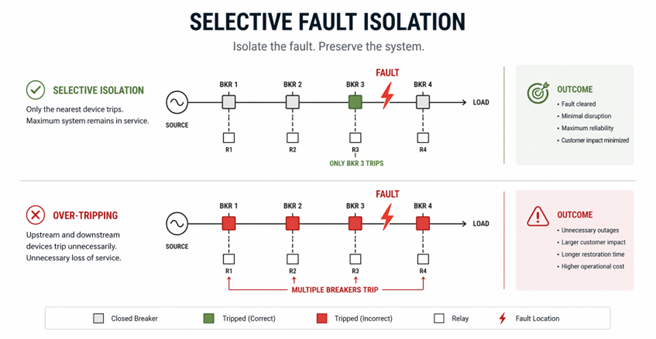
When a fault happens, the system has a narrow window to respond. Devices must detect the event, decide whether it falls within their zone of protection, and operate in a defined sequence. Which breaker trips first. Which section is isolated. How quickly current is interrupted. How much of the system remains in service. These outcomes are not incidental. They are the product of protection coordination. Well-coordinated systems:- isolate only the faulted section
- clear faults within required time limits
- preserve service continuity for the rest of the network
- trip multiple feeders or substations unnecessarily
- leave faults uncleared or delayed
- stress equipment through prolonged fault current
- create uncertainty during restoration
Why coordination is more difficult in modern grids
The principles of relay coordination are well established. What has changed is the environment in which they are applied.Inverter-based resources and BESS
Solar, wind, and battery energy storage systems contribute fault current differently from synchronous machines. Their behavior is:- limited and control-driven
- time-varying during the fault
- sensitive to grid conditions and settings
- relay pickup sensitivity
- directional elements
- coordination margins across devices
Distributed generation and complex interconnections
As generation and storage are embedded across the network, fault current paths become less intuitive. Power can flow from multiple directions, complicating:- zone selectivity
- time-current coordination
- feeder and substation protection schemes
Large, power-electronics-heavy loads (data centers)
High-density loads can influence voltage and current profiles during faults, affecting how protection devices “see” the event and respond. The result is a system where traditional assumptions do not always hold. Coordination must be validated against actual system behavior not inherited from past designs.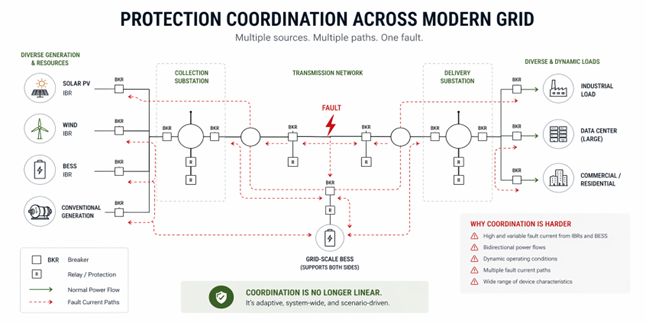
From relay settings to system behavior
Protection coordination studies are often framed as setting relays and producing time-current curves. That is necessary, but incomplete. Effective coordination requires understanding:- fault levels across different system configurations
- minimum and maximum current scenarios (critical with inverter-based resources)
- clearing times relative to equipment withstand and stability limits
- interaction with upstream and downstream protection
- behavior under abnormal conditions (contingencies, switching, partial outages)
- breaker rating and interrupting duty
- protection philosophy (instantaneous vs time-delayed)
- system topology (radial vs networked sections)
- operational flexibility during maintenance and contingencies
Where projects encounter avoidable risk
Protection issues rarely surface at the concept stage. They appear later during detailed engineering, commissioning, or initial operation. Common patterns include:- insufficient fault current for relay pickup in IBR-heavy systems
- miscoordination between utility and facility protection at the point of interconnection
- over-tripping due to conservative or misaligned settings
- delayed fault clearing that exceeds equipment thermal limits
Bringing coordination forward in design
Projects that perform reliably tend to integrate protection coordination early alongside grid interconnection and system impact studies. This allows teams to:- validate that relay schemes align with actual fault behavior
- ensure selectivity across feeders, substations, and interconnection points
- confirm clearing times meet both protection and stability requirements
- anticipate upgrade needs before they affect timelines
A system-level approach in practice
In complex projects renewable integration, BESS deployments, and data center interconnections coordination cannot be isolated from the rest of the system. It must be consistent with:- short circuit results (maximum and minimum fault current)
- dynamic stability requirements (clearing times, ride-through)
- control system behavior (especially for inverter-based resources)
- utility protection standards and interconnection agreements
Reliability is determined in milliseconds
Protection coordination ultimately comes down to time. Milliseconds determine whether:- a fault is isolated locally or propagates
- equipment is protected or stressed
- the system recovers quickly or enters an unstable condition
Designing for the moment that matters
As grids become more dynamic with inverter-based resources, storage, and complex interconnections the importance of protection coordination will continue to increase. The shift is already clear:- from back-end configuration to front-end design consideration
- from component-level settings to system-level coordination
- from assumed behavior to validated performance under real conditions