
The Owner’s Engineer Is What Keeps Complex Power Projects From Breaking at the Edges
A practical perspective on system integration, interconnection risk, and why the Owner’s Engineer role now defines project outcomes
By the time a power project reaches detailed engineering, most of the major decisions are already locked in.
Site selected. Capacity defined. Interconnection pathway identified. Timelines committed.
On paper, everything aligns.
What is less certain is whether the system; across generation, transmission, protection, controls, and compliance, will actually function as intended when it is built and energized.
That gap is where the Owner’s Engineer becomes critical.
The challenge is not design quality but system alignment.
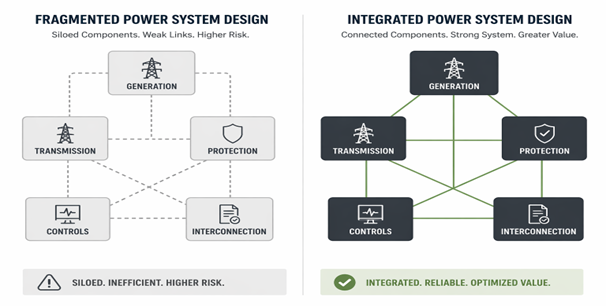
Modern energy infrastructure projects are rarely limited by technical capability. Individual components; generation assets, substations, protection systems, control platforms are generally well designed.
The challenge emerges at the interfaces.
Common failure points are not in single disciplines, but between them:
- assumptions in interconnection studies not carried into detailed design
- protection schemes that do not align with system configuration
- control strategies that interact in unintended ways
- compliance requirements that are addressed in isolation rather than embedded in operations
Each element can be correct on its own. The system can still fail to perform.
This is fundamentally an integration problem.
Why this is becoming more pronounced
The role of the Owner’s Engineer has always existed. What has changed is the complexity of the system being delivered.
Several factors are driving this shift:
Inverter-based resources and BESS integration
Solar, wind, and battery energy storage systems introduce control-driven behavior that must be coordinated across the system. Misalignment in controls can lead to instability, performance issues, or non-compliance with grid requirements.
Large load interconnections and data centers
Hyperscale data centers and industrial electrification projects require precise coordination between utility infrastructure, on-site systems, and backup configurations. Timing, redundancy, and system response all matter.
Evolving grid interconnection requirements
Utilities and system operators are placing greater emphasis on detailed studies, dynamic stability, short circuit analysis, and protection coordination. These studies must align with actual design and operation.
Increasing regulatory and compliance pressure
NERC compliance, grid codes, and cybersecurity requirements introduce additional layers that must be integrated into both design and operation.
As complexity increases, the margin for misalignment decreases.
What the Owner’s Engineer actually does
The Owner’s Engineer is often misunderstood as a review function.
In practice, the role is far more active.
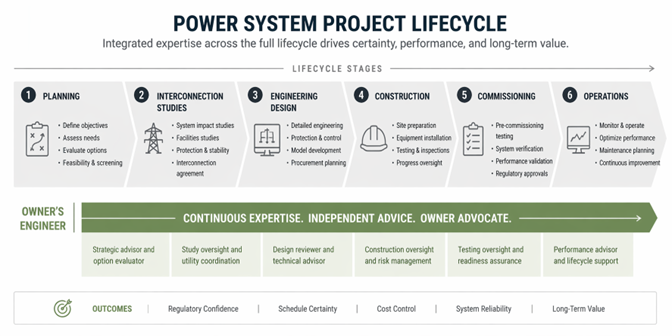
An effective Owner’s Engineer operates across the full project lifecycle:
- early-stage planning and feasibility
- interconnection and system impact studies
- detailed engineering and design coordination
- construction support and commissioning
- operational readiness and compliance alignment
The objective is not to review outputs. It is to ensure that decisions made at each stage remain consistent with how the system must ultimately perform.
This includes:
- challenging assumptions in studies and models
- validating that design choices reflect real operating conditions
- coordinating across disciplines to ensure alignment
- identifying risks before they are embedded in the system
The value lies in continuity.
Where projects succeed
Across power projects, the difference between smooth execution and delay is rarely intent or capital.
It is clarity.
Projects that move forward effectively tend to have:
- early visibility into grid constraints and interconnection requirements
- alignment between system studies and engineering design
- coordinated protection, control, and operational strategies
- clear understanding of how the system will behave under stress
Projects that struggle often encounter:
- late discovery of upgrade requirements
- misalignment between studies and actual design
- integration issues during commissioning
- unexpected behavior under real operating conditions
These outcomes are not random. They reflect how well the system was integrated from the start.
The Owner’s Engineer as an integration function
The most effective way to understand the Owner’s Engineer role is not as oversight, but as integration.
The role connects:
- grid planning and transmission planning with project design
- interconnection studies with equipment selection and configuration
- dynamic stability and short circuit analysis with protection and controls
- compliance requirements with operational execution
This integration ensures that:
- what is modeled can be built
- what is built can be connected
- what is connected can be operated reliably
Without this continuity, gaps emerge.
From early decisions to long-term performance
Many of the most important project decisions are made early, often before detailed engineering begins.
These include:
- site selection and interconnection strategy
- system architecture and redundancy design
- choice of generation, storage, and control technologies
If these decisions are not informed by a full-system perspective, they can introduce constraints that are difficult to resolve later.
The Owner’s Engineer plays a critical role in ensuring that:
- early assumptions are technically sound
- system studies reflect realistic conditions
- design decisions remain consistent with operational requirements
This reduces the risk of redesign, delay, and performance issues downstream.
Our approach to the Owner’s Engineer role
PowerTek approaches the Owner’s Engineer role as a system integration function across power systems engineering, grid planning, interconnection, and project delivery.
The focus is on:
- aligning system studies with engineering design
- ensuring consistency between planning, modeling, and execution
- identifying risks early across transmission, generation, and load integration
- translating complex system behavior into clear, actionable decisions
This approach supports projects across:
- renewable energy and BESS integration
- transmission and grid infrastructure
- large load interconnections, including data centers
- compliance and operational readiness
The objective is not oversight for its own sake. It is ensuring that the system works as a whole.
Success is defined at the system level
In complex power projects, success is not measured by whether individual components perform as specified.
It is measured by whether the system performs as intended—under real conditions.
That includes:
- stable operation under disturbance
- coordinated protection and control behavior
- alignment with grid requirements and compliance standards
- predictable performance over time
These outcomes are determined long before commissioning.
They are shaped by how well the system is integrated across every stage of development.
The role is becoming central and not optional
As energy infrastructure becomes more complex and interconnected, the Owner’s Engineer role is shifting from supportive to central.
The need is no longer just for review.
It is for coordination, alignment, and continuity.
Because in modern power systems, the risk is not that individual elements fail.
It is that they fail to work together.