
Battery Energy Storage Systems Is Changing How the Grid Operates
A technical perspective on BESS studies, grid interaction, and why battery behavior, not capacity is now the critical design variable
Battery energy storage systems (BESS) are often positioned as a solution to capacity constraints.
In practice, they are a tool for reshaping how power flows across the system over time.
That distinction is operationally significant.
BESS changes system behavior, not just system capacity
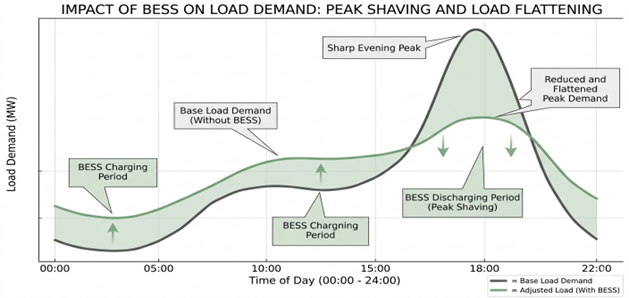
At a high level, storage is straightforward. Charge when excess energy is available. Discharge when demand is high.
This framing is useful, but incomplete.
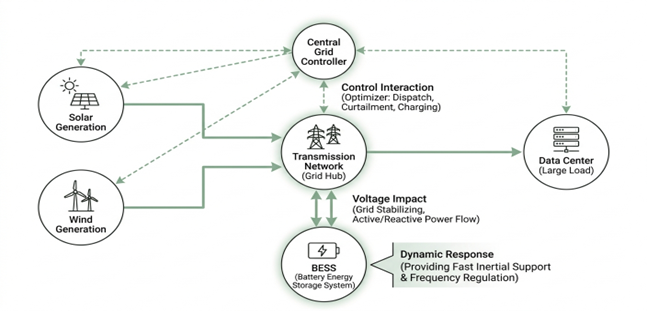
A BESS installation is not a passive asset. It is an active, control-driven system that interacts continuously with:
- voltage conditions across the network
- system frequency and inertia
- protection schemes and fault response
- generation dispatch and load behavior
As a result, BESS does not simply “add capacity.” It alters system behavior in ways that are highly dependent on control logic, configuration, and network conditions.
From a planning perspective, this shifts the focus from how much storage is installed to how that storage behaves.
Why traditional sizing approaches are no longer sufficient
Early-stage BESS projects often begin with sizing calculations:
- required MWh for peak shifting
- MW capacity for demand support
- duration aligned with market or operational objectives
These inputs are necessary, but they do not capture system impact.
Key performance questions sit outside simple sizing:
- How does the BESS respond to voltage disturbances?
- What is its contribution during fault conditions?
- How does it interact with inverter-based generation nearby?
- Does it stabilize or amplify oscillations under dynamic conditions?
- How does it behave under different control modes (grid-following vs grid-forming)?
Without detailed BESS system studies, these questions remain unresolved until late in the project lifecycle.
Where BESS introduces complexity into the grid
The complexity introduced by battery storage is not uniform. It is most pronounced in systems where multiple dynamic elements interact.
Inverter-based resource environments
BESS often operates alongside solar and wind generation. These systems rely on power electronics and control algorithms, creating potential for:
- control interaction
- oscillatory behavior
- sensitivity to grid strength
Weak or constrained grids
In areas with limited transmission capacity or lower system inertia, BESS can have an outsized influence on:
- voltage stability
- frequency response
- fault detection and clearing behavior
Large load interconnections (data centers)
In high-density load environments, storage is increasingly used to:
- manage peak demand
- provide backup support
- enable phased interconnection
In these cases, the interaction between BESS, UPS systems, and upstream infrastructure becomes a critical design factor.
The expanding role of BESS in project development
Across current projects, batteries are expected to perform multiple roles simultaneously:
- peak shaving and load shifting
- grid support and ancillary services
- resilience and backup integration
- enabling interconnection in constrained networks
Each of these functions places different demands on the system.
For example:
- peak management favors predictable charge/discharge cycles
- grid support requires fast dynamic response
- resilience requires coordination with protection and backup systems
These objectives can conflict if not properly coordinated through system design.
Why detailed BESS studies are now essential
As BESS applications expand, the need for detailed analysis increases.
Effective battery energy storage system studies typically include:
- power flow analysis to assess integration into the network
- short circuit analysis to evaluate fault contribution and protection implications
- dynamic stability studies (PSSE) to evaluate system response under disturbance
- EMT modeling (PSCAD) where control interactions and fast dynamics are critical
These studies provide visibility into:
- how the battery interacts with the grid
- whether it supports or degrades system stability
- how it behaves under abnormal or stressed conditions
- what control strategies are required for reliable operation
Without this analysis, BESS performance is assumed rather than understood.
From asset deployment to system integration
Projects that perform well tend to follow a different approach:
- BESS is modeled early alongside generation and load
- control strategies are evaluated in the context of the full system
- interactions with protection schemes and grid conditions are tested
- multiple operating scenarios are considered, not just the base case
This approach reduces the risk of:
- unexpected system behavior during commissioning
- late-stage design changes
- performance gaps between modeled and actual operation
PowerTek supports utilities, developers, and large energy users through BESS studies, grid integration analysis, and power system modeling.
The focus is on:
- understanding how battery systems behave within real network conditions
- evaluating interactions with inverter-based resources and large loads
- assessing performance under fault, disturbance, and dynamic scenarios
- translating technical analysis into practical system design decisions
This ensures that BESS installations deliver not only on capacity targets, but on operational expectations.
The real question is not capacity. It is response.
Battery systems will respond to system conditions.
As grids become more dynamic and interdependent, the importance of understanding that behavior increases.
In this context:
- capacity defines what the system can store
- behavior defines how the system performs
That distinction is what determines whether a BESS project adds value—or introduces risk.