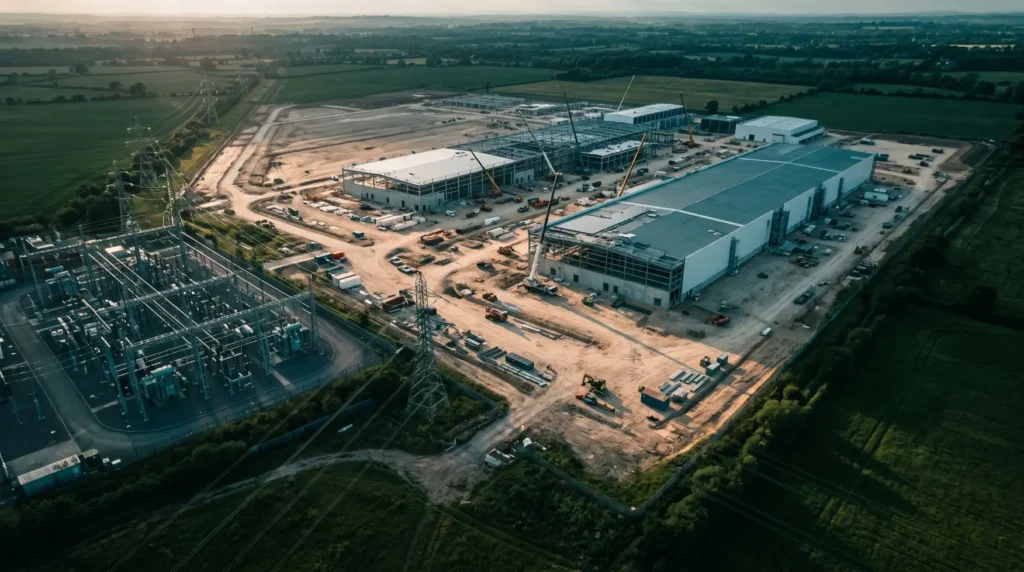
Land, fiber and zoning permits matter, but a data center cannot move forward safely on a power assumption alone. A nearby transmission line does not guarantee spare capacity, and a utility’s network upgrade timeline often diverges sharply from a developer’s building schedule.
As individual campuses scale toward tens and hundreds of megawatts, electrical deliverability has become the single most decisive gating item in site selection. Treating interconnection as a post-closing engineering task exposes capital, customer commitments and construction schedules to multi-year delays.
An early technical review should compare candidate points of interconnection (POIs), substation thermal and voltage limits, contingency cases and phased load growth—then distinguish between what an owner can decide immediately and what requires a formal utility study.
The first feasibility screen will never promise utility approval. Its real value is preventing premature land, procurement or commercial commitments before the grid path is properly understood.
Why Substation Proximity Misleads Site Selection
Site maps routinely attract developers to parcels adjacent to 138 kV, 230 kV or 345 kV corridors. In practice, physical proximity to high-voltage steel reveals almost nothing about available injection or withdrawal headroom.
Transmission capacity depends on thermal ratings under normal (N-0) and contingency (N-1 or N-1-1) operating conditions across a much wider regional footprint. Even when a nearby substation has open physical bay positions, upstream transmission lines, autotransformers or reactive support limits may already be saturated by existing demand and earlier-queued large loads.
Before valuing a parcel on apparent power availability, screening should inspect regional transmission topology, seasonal thermal bottlenecks and known queue congestion across the surrounding load zone.
Comparing Candidate Points of Interconnection and Phasing
Single-path site diligence leaves a project exposed if its primary POI triggers costly network upgrades. Where multiple transmission lines, utility circuits or adjacent substations serve an industrial corridor, early power-flow screening can rank candidate POIs side by side before commercial terms lock.
- Phased energization testing: Evaluate whether an initial megawatt block can interconnect on existing facilities while later phases wait for permanent substation or line upgrades.
- Contingency sensitivity: Identify which N-1 line or transformer outages restrict deliverable firm demand and how much load would face operating limits during maintenance windows.
- Upgrade scope separation: Separate dedicated interconnection facilities at the campus boundary from deeper network upgrades whose scope, permitting and cost recovery sit outside the developer’s control.
- Bridge alternatives: Compare interim capacity against temporary generation or phased utility upgrades alongside land, lease and financing assumptions.
Queue Position, Study Scopes, and Curtailment Assumptions
Across major ISOs, RTOs and vertically integrated utilities, large-load interconnection procedures are tightening rapidly. Understanding how a local utility classifies a project—whether under a standard retail service request, a large-load tariff or a formal transmission cluster study—shapes both schedule certainty and collateral requirements.
Flexible or interruptible service offers are increasingly proposed as a pathway to earlier energization. While workable for certain compute profiles, flexible capacity must be stress-tested against customer service-level agreements, cooling loads and any on-site backup generation air-permit limits before execution.
Defining the Utility-to-Campus Demarcation Boundary
Misalignment at the electrical demarcation point is a frequent source of cost escalation during detailed design. Decisions made during early feasibility determine who builds, owns, operates and procures the high-voltage interface between the utility grid and the data center switchyard.
Developers and utilities should establish clear responsibility matrices covering voltage level, metering, breaker-and-a-half versus ring-bus configurations, line-extension easements and transformer spares. Because extra-high-voltage power transformers and high-voltage switchgear carry long manufacturing lead times, equipment procurement specifications need alignment well before final facilities studies conclude.
Fault Duty, Harmonics, and Dynamic Compute Loads
Interconnection diligence is not purely steady-state thermal math. High-density AI and cloud workloads introduce sharp dynamic load swings, power-electronic harmonic currents and strict voltage-ride-through sensitivities that both the utility and the campus electrical design must accommodate simultaneously.
Early short-circuit and power-quality reviews verify whether existing substation breakers have sufficient interrupting duty once a new transformer bank energizes, and whether harmonic filtering or dynamic reactive compensation (such as capacitor banks or STATCOMs) will be required to satisfy IEEE 519 and utility flicker criteria.
What a Bankable Site Power Diligence Package Includes
Whether preparing an internal investment committee memo or underwriting project finance, a defensible site power plan translates electrical constraints into clear go/no-go commercial decisions:
- Multi-POI power-flow comparison: Ranked technical and schedule screening across nearby transmission voltages and candidate substations.
- Preliminary single-line and demarcation concept: Clear utility-versus-customer ownership boundaries, spatial footprints for the customer substation and corridor routing.
- Schedule and upgrade risk register: Realistic energization windows by phase, critical-path equipment lead items and identified upstream transmission dependencies.
- Defined utility engagement roadmap: The exact load profiles, ramp schedules and engineering assumptions required to lodge a complete utility application without costly resubmittals.
Strong sites win when land control, customer ramp schedules and utility electrical reality are tested as one integrated plan from day one.