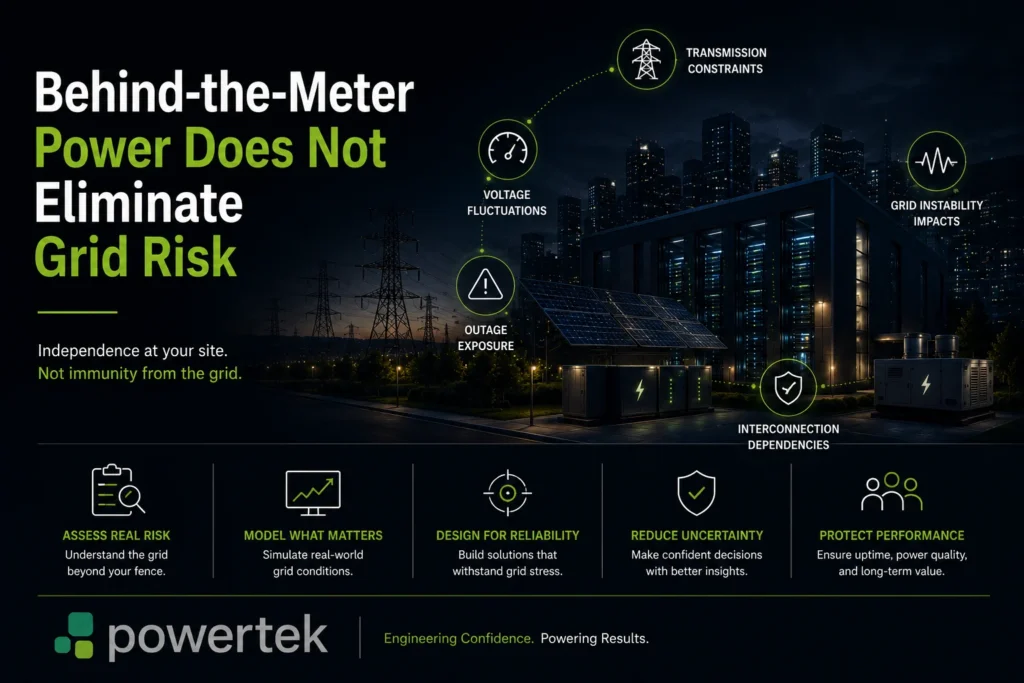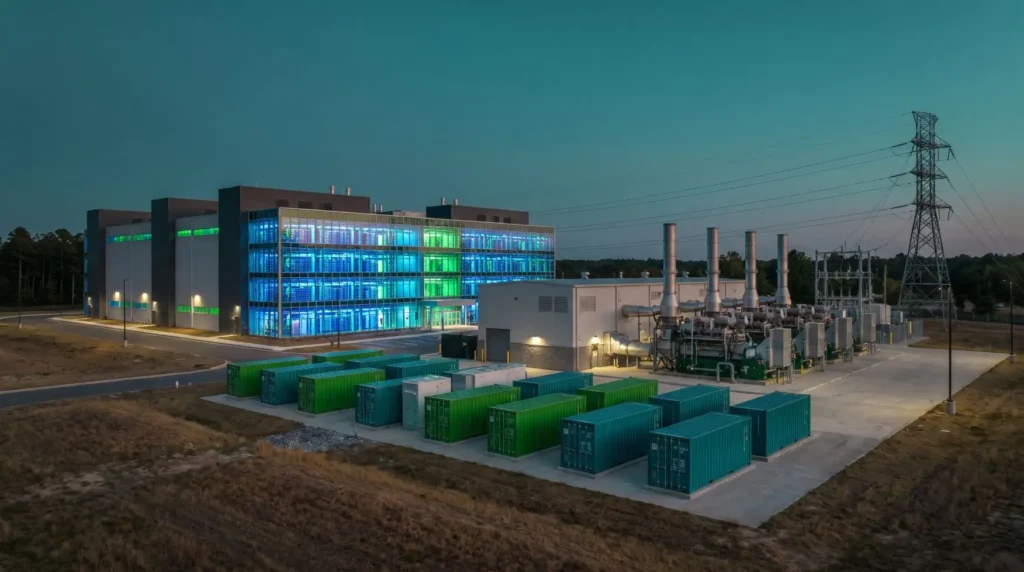
Dedicated on-site generation and battery energy storage systems (BESS) can help a data center unlock constrained corridors or bridge multi-year utility upgrade delays. What they do not eliminate is the need for a rigorous grid and commercial contract plan.
Even a campus anchored by substantial behind-the-meter (BTM) capacity must still engineer for electrical faults, synchronization, protective relaying, dynamic step-load transients and forced or planned generator outages. Equally important, every operating assumption must match how utility tariffs, fuel supply contracts and EPC obligations allocate risk.
When technical studies and commercial agreements are developed in separate silos, developers routinely discover late in design that contractual backup rights, air-permit runtime allowances and protection settings contradict one another.
A thorough BTM assessment brings steady-state power flow, transient stability, protection coordination, storage sizing, import/export rules and commercial risk allocation into one unified basis of design.
Why On-Site Generation Does Not Eliminate Utility Questions
“Behind the meter” covers several distinct electrical architectures, each carrying different regulatory and physical utility interfaces:
- Fully islanded campuses: Operating electrically disconnected from the local grid requires self-sufficient frequency and voltage regulation, full internal N+1 or N+2 generation redundancy, black-start capability and sufficient short-circuit strength to clear internal faults cleanly.
- Grid-parallel campuses: Generating in parallel with a utility feed—typically under zero-export or capped-import rules—triggers formal utility interconnection review, protective relaying mandates and standby tariff structures.
- Bridge-to-grid transitions: Using temporary generation or hybrid prime power ahead of a permanent utility substation energization requires a seamless cutover plan so live racks are never exposed to unprotected parallel operation or extended transfers.
Clarifying which topology applies across year one through full buildout is the essential first step before ordering engines, turbines or medium-voltage switchgear.
Parallel Operation, Islanding, and Protection Coordination
Adding rotating machines or inverter-based resources inside a campus fundamentally alters fault levels, fault-current directions and ground-fault behavior. Utilities focus closely on any parallel source that could feed an external transmission or distribution fault or inadvertently energize a de-energized line crew segment.
An engineering-grade BTM plan resolves utility-grade transfer trip requirements, synchro-check relays, anti-islanding logic and directional overcurrent coordination early. For campuses that transition between grid-parallel and islanded states, engineers must also verify breaker interrupting ratings across both the minimum-fault islanded case (where relays can fail to pick up) and the maximum-fault parallel case (where combined utility plus generator fault contribution can exceed bus bracing).
BESS Integration, Inertia, and Compute Step-Load Bridging
Thermal prime movers—whether reciprocating engines or gas turbines—have finite mechanical ramp rates. Meanwhile, high-density data center workloads can step sharply during cluster initialization or drop abruptly during workload migration.
Pairing generation with properly sized BESS and coordinated plant controls absorbs sub-second power imbalances, supports synthetic inertia or grid-forming voltage stiffness, and prevents frequency excursions from tripping critical uninterruptible power supply (UPS) inputs onto battery discharge. Plant-level controller hardware-in-the-loop assumptions, state-of-charge reserves and inverter fault contribution should be modeled before locking control-system vendors.
Import, Export, and Standby Tariff Boundaries
Commercially, the utility boundary is governed by more than wires. Standby or backup power tariffs vary widely across utilities and can carry steep monthly demand ratchets if even a brief unplanned grid import occurs during a generator trip.
In addition, many jurisdictions examine whether multi-entity BTM power sales cross state public-utility franchise boundaries or FERC wholesale market rules if excess energy exports across the meter. Protective reverse-power relays, fast load-shedding schemes and battery charge/discharge envelopes must therefore be tuned specifically to enforce commercial import and export thresholds without causing nuisance plant shutdowns.
Aligning EPC, Interconnection, Fuel, and Service Agreements
Bankable BTM projects ensure that every commercial contract references the exact same operating envelope and boundary conditions:
- Firm capacity and outage coverage: Define who covers reserve margin during planned overhaul windows or unscheduled turbine/engine trips, and whether utility standby is contractually guaranteed.
- Delivery delay and commissioning risk: Align EPC completion milestones, long-lead equipment float and interconnection energization dates so energy service obligations do not trigger before commissioning tests conclude.
- Fuel logistics and environmental caps: Verify natural gas lateral firm-transportation pressures, dual-fuel liquid storage autonomy and NOx/CO annual operating-hour permit ceilings under realistic annual dispatch factors.
- Upgrade and curtailment allocation: Specify clearly which party absorbs utility protection retrofits, telemetry upgrades or transmission curtailment directives.
An Integrated BTM Feasibility and Execution Checklist
Before selecting between grid-delivered supply and dedicated behind-the-meter power, decision-makers should require one side-by-side diligence framework covering:
- Steady-state load flow, short-circuit duty and protection coordination across both islanded and grid-parallel operating modes.
- Dynamic transient simulation validating step-load response, BESS sizing and UPS transfer stability.
- Commercial tariff, standby-charge and regulatory compliance review against import/export control settings.
- Fully reconciled EPC, O&M, fuel-supply and utility interconnection schedules on a shared risk matrix.
With studies and contracts built on the same operating truth, behind-the-meter infrastructure becomes a durable schedule and resilience advantage rather than an unpriced operational surprise.