
Flexible Data Centers May Become the Next Grid Advantage
Why AI infrastructure, large-load interconnection, BESS coordination, and utility planning may shift from firm demand to controllable load
The future data center may not behave like a fixed load.
For years, utilities treated large loads as firm demand. A customer requested 100 MW, 300 MW, or 500 MW. The planning question was direct.
Can the grid serve it?
That question still matters. But AI infrastructure is changing the next question.
Can the load respond when the grid needs flexibility?
That distinction could reshape data center interconnection, utility planning, transmission planning, BESS strategy, and grid reliability.
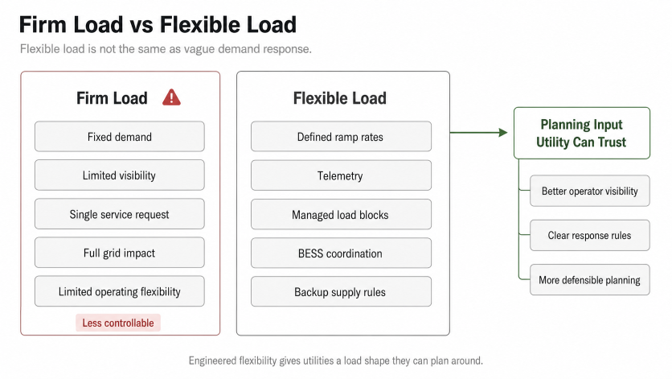
Flexible load is not the same as vague demand response
Flexible load only matters when the utility can plan around it.
A data center saying it can reduce load is not enough. A utility needs defined operating behavior: ramp rates, telemetry, operator visibility, control limits, response duration, backup supply rules, and clear performance during grid stress.
Without those details, flexibility remains a claim.
With those details, flexibility becomes a planning input.
That is the difference between informal demand response and engineered flexibility.
A flexible data center should answer practical questions:
- How much load can move?
- How fast can it move?
- How long can it stay reduced?
- Who controls the action?
- What telemetry will the utility see?
- How does BESS support the response?
- What happens during a contingency?
Those answers belong in the interconnection conversation, not after the project is already committed.
Large-load planning is moving from capacity to behavior
Utilities cannot plan AI load only by peak MW.
A 300 MW data center with no flexibility creates one planning problem. A 300 MW data center with defined load blocks, BESS coordination, backup supply, and operator visibility creates another.
The requested load may be the same.
The system impact may not be.
A flexible load can help manage local constraints, reduce peak exposure, support phased service, or protect reliability during grid stress. It can also create new study questions. Controls must work. Telemetry must be visible. Backup supply must follow clear rules. BESS charging and discharging must match the system need.
The grid does not value flexibility because it exists.
It values flexibility when it can trust the response.
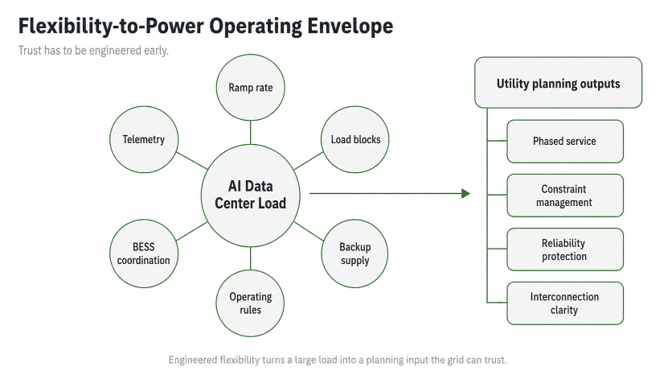
Trust has to be engineered early
Utilities will not plan around flexibility they cannot verify.
That means flexible data center interconnection needs engineering discipline before site commitments harden. The project team must define operating envelopes, study system impacts, and confirm what the utility can count on during normal and stressed conditions.
This is where power systems engineering becomes practical risk control.
Transmission planning shows where constraints may appear. Load flow studies test normal and contingency performance. Dynamic studies test system response during disturbances. Short circuit analysis and protection coordination confirm fault behavior. BESS studies test whether storage supports flexibility or creates new operating issues.
PowerTek sees this pattern across large-load analysis, BESS integration, and utility planning. In confidential U.S. utility master planning through 2050, PowerTek supported planning around future load growth, grid constraints, and investment sequencing. In BESS lifecycle support for IESO and owner’s engineering for Qulliq Energy Corporation, PowerTek addressed how storage and system behavior affect reliability, not only installed capacity.
Those lessons now apply to AI infrastructure.
The useful question is not only what load is requested. It is what behavior the system can count on.
Flexibility can change the service plan
Flexible load can help a project move from a single large request to a phased service strategy.
A utility may not be able to serve the full load on day one. It may support an initial block, then add capacity after substation work, transmission upgrades, or protection changes. Flexible operation may help bridge the gap if the customer can provide predictable response.
That does not remove the need for upgrades.
It can change timing, sequencing, and operating risk.
For example, a data center may use BESS to reduce peak exposure during constrained hours. It may define load blocks that operators can manage. It may coordinate backup supply with utility requirements. It may provide telemetry so the utility can see and verify response.
Each option needs study.
A flexible load that cannot perform during stress has little planning value. A flexible load with clear rules can become part of the utility’s service strategy.
Flexibility-to-power may become a real advantage
Speed-to-power has dominated data center development.
The next advantage may be flexibility-to-power.
Developers who can prove controllable load behavior may give utilities more planning options. Utilities may still need upgrades, but they may have clearer ways to phase service, manage constraints, and protect reliability.
That could matter for AI campuses, hyperscale data centers, advanced manufacturing, and other large-load projects.
The data centers that get served first may not only be the ones with the strongest sites.
They may be the ones with the clearest operating envelope.
The next question for AI infrastructure is not only whether the grid can serve the load.
It is whether the load can behave in a way the grid can plan around.