
PSCAD and PSS/E Studies Are Now Core to Modern Grid Planning
How EMT modeling, IBR studies, and dynamic system analysis help utilities and developers understand how the grid behaves under stress
Most grids were built for slower system dynamics.
For decades, planning studies relied heavily on steady-state assumptions. Generation was centralized. System inertia was higher. Control interactions were easier to predict. Renewable penetration was lower across most interconnections.
That operating environment no longer exists.
Inverter-based resources now shape how the grid behaves. Solar, wind, battery energy storage systems, HVDC equipment, and power-electronics-heavy loads respond differently than synchronous machines. Their behavior depends on controls, settings, system strength, and fault conditions.
That changes how projects need to be studied.
A system can pass a load flow study and still face dynamic performance issues. Voltage can recover slowly after a fault. Controls can interact in unexpected ways. Oscillations can appear after switching events. Harmonics can create equipment stress or power quality concerns.
These issues are not visible in a base case.
They show up when the system is disturbed.
Advanced modeling now sits earlier in the project lifecycle
PSCAD and PSS®E are now central tools in grid planning, interconnection studies, and dynamic system analysis.
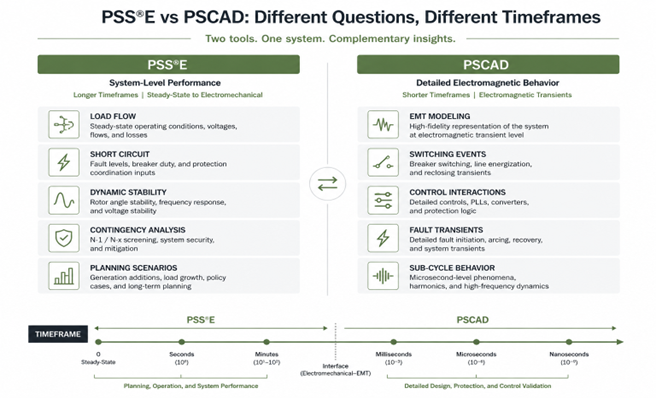
PSS®E remains a core platform for power flow, short circuit, and dynamic stability studies. It helps engineers assess how the system performs under expected operating conditions and credible contingencies.
PSCAD adds another layer. It allows engineers to study electromagnetic transients, fast switching events, control interactions, and sub-cycle system behavior. This matters when the project includes inverter-based resources, BESS, HVDC, renewable interconnections, or large industrial loads.
The two tools answer different questions.
PSS®E helps answer: can the system remain stable across planning scenarios?
PSCAD helps answer: what happens in the milliseconds after a fault, switching event, or control response?
Both questions now matter earlier.
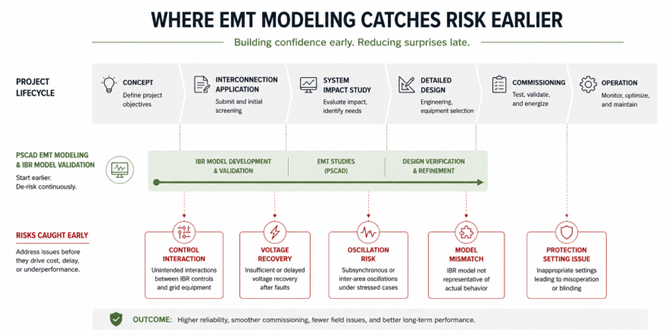
Utilities and developers are no longer waiting until commissioning to identify dynamic performance issues. EMT modeling, IBR studies, and model validation now influence interconnection design, protection settings, control tuning, and equipment configuration during development.
That shift reduces late-stage rework.
IBR studies are now a design input, not a final check
Inverter-based resources behave through software-defined controls.
That creates a different planning problem. Engineers must understand how the controls respond under abnormal conditions, not just how the asset performs at rated output.
Important study questions include:
- How does the inverter respond during low-voltage ride-through?
- Does the BESS support voltage recovery or complicate it?
- Do nearby inverter-based resources interact during disturbances?
- Are oscillations damped quickly enough?
- Does the PSCAD model match the PSS®E model closely enough for planning use?
- Are protection settings aligned with actual fault current behavior?
These questions affect real decisions.
They influence plant design, reactive support sizing, relay settings, grid code compliance, and interconnection risk. When the answers come late, projects face redesign, schedule pressure, and difficult discussions with utilities or system operators.
PowerTek often sees this issue in renewable and BESS interconnection work. A model may look acceptable in a basic planning review, but fail when tested under fault recovery, weak grid conditions, or control interaction scenarios. Correcting those issues early gives the project team more options.
PSCAD model rescue and validation now matter more
A poor model can become a project risk.
An unstable PSCAD model can delay studies. A model that does not match PSS®E results can create questions during interconnection review. A model that does not reflect vendor control behavior can produce misleading conclusions.
Model validation is now part of project readiness.
Good validation checks whether the model behaves consistently across expected events. It also compares EMT results against RMS simulations where appropriate. This helps utilities and developers confirm that study conclusions reflect the asset, not a modeling error.
PowerTek’s work in this area focuses on practical study outcomes. The goal is not just to run PSCAD simulations. The goal is to identify whether the system response makes sense, where the model may be unstable, and what changes are needed before the project reaches commissioning or compliance review.
That distinction matters.
A clean model is not valuable because it looks polished. It is valuable because it supports decisions that hold up under review.
Dynamic behavior now defines grid performance
Modern grids do not operate as static systems.
They are shaped by fast controls, inverter response, storage dispatch, protection actions, and changing system strength. These factors determine whether a project performs as expected when the system is stressed.
That is why PSCAD studies, EMT modeling, PSS®E dynamic studies, IBR model validation, and grid stability analysis are now central to project development.
For utilities, these studies support reliability planning and interconnection review.
For developers, they reduce technical risk before project assumptions become fixed.
For large load customers, including data centers, they help evaluate how the system behaves during disturbances, switching events, and power quality events.
PowerTek supports this work across utilities, renewable developers, BESS owners, and large load customers. The focus is direct: study the system under non-ideal conditions, identify the risks early, and translate model results into engineering decisions.
Modern grid performance is no longer defined by whether the system looks stable at equilibrium.
It is defined by what happens after the disturbance begins.