
Short Circuit Analysis Is What Protects the System When Things Go Wrong
A practical perspective on fault current, protection coordination, and why short circuit studies now shape system design
Short circuit analysis rarely gets attention in the early stages of a project.
Most discussions focus on capacity, interconnection timelines, and how quickly a system can be brought online. Fault levels and protection margins tend to sit in the background, treated as something to be checked and signed off later.
This is where some of the most critical issues emerge.
The system is defined by how it behaves under fault
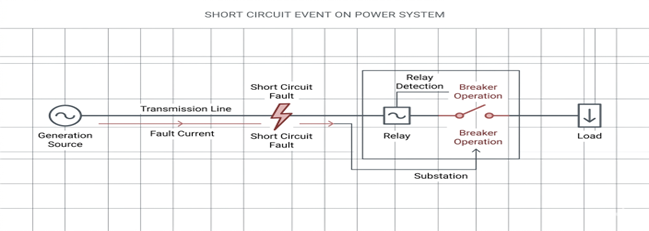
A short circuit event is one of the most severe conditions a power system will experience.
Fault current can rise rapidly, placing stress on breakers, transformers, cables, and protection systems. Protection must detect, isolate, and clear the fault within defined time limits, often in cycles.
When this behavior is not fully understood:
- equipment may be under- or over-rated
- breakers may not interrupt fault current within their duty
- relays may misoperate or fail to coordinate
- local issues can propagate into wider system disturbances
Steady-state studies confirm that a system can operate. Short circuit analysis confirms that it can fail safely.
Why fault behavior is changing
The nature of fault current is evolving with the grid.
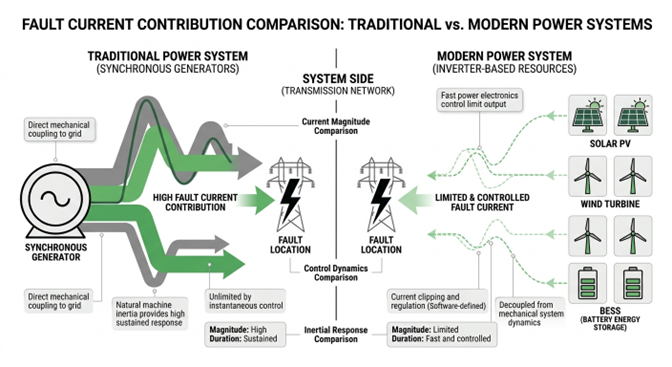
Historically, fault levels were dominated by synchronous generation. Contributions were relatively predictable, and protection philosophies were built around that behavior.
That model is changing.
Inverter-based resources (IBRs)
Solar, wind, and BESS do not contribute fault current in the same way as synchronous machines. Their response is:
- limited by controls and protection
- time-dependent and often capped
- influenced by grid strength and control settings
In some cases, fault current is lower and harder to detect, complicating relay sensitivity and selectivity.
Battery Energy Storage Systems (BESS)
BESS introduces fast power electronics and control modes (grid-following or grid-forming) that can:
- alter fault contribution profiles
- affect protection timing and coordination
- change system behavior during and after fault clearance
Large, concentrated loads (data centers)
Hyperscale data centers introduce dense, power-electronics-heavy loads. Their interaction with upstream systems can:
- influence voltage behavior during faults
- affect protection schemes in shared infrastructure
- change the effective impedance seen by protection devices
The result is a system where traditional assumptions do not always hold. Fault behavior must be studied, not inferred.
From compliance check to design input
Short circuit analysis has traditionally been treated as a compliance step:
- calculate fault levels
- confirm equipment ratings
- verify protection settings
That approach is no longer sufficient.
Short circuit studies now inform core design decisions:
- breaker rating and interrupting capacity
- relay selection, settings, and coordination
- bus configuration and system topology
- grounding strategy and fault detection methods
- upgrade requirements at interconnection points
When analysis is delayed, these decisions become constrained and expensive to change.
What effective short circuit analysis looks like
High-quality short circuit analysis goes beyond a single fault calculation.
It requires:
- accurate system modeling (including source impedance, network topology, and equipment data)
- evaluation across multiple fault types (three-phase, line-to-ground, line-to-line)
- assessment under different operating conditions and system configurations
- consideration of both maximum and minimum fault scenarios
Critically, it must be connected to protection coordination:
- ensuring relays operate in the correct sequence
- verifying clearing times meet system requirements
- maintaining selectivity to isolate only the faulted section
In modern systems, this often includes coordination with:
- inverter control behavior
- BESS operating modes
- utility protection schemes at the point of interconnection
The objective is not just to meet limits. It is to ensure the system responds predictably under stress.
Where projects encounter avoidable risk
In practice, short circuit issues tend to surface late; during detailed design, commissioning, or interconnection review.
Common patterns include:
- fault levels exceeding breaker ratings, requiring equipment changes
- insufficient fault current for reliable relay operation in IBR-heavy systems
- miscoordination between utility and facility protection schemes
- unexpected upgrade requirements at substations or interconnection points
These issues are rarely due to a lack of capability. They are the result of timing. When short circuit analysis is deferred, risk accumulates.
Integrating short circuit studies into planning
Projects that move efficiently tend to integrate short circuit analysis early; alongside grid interconnection and system impact studies.
This allows teams to:
- align equipment specifications with actual fault duty
- design protection schemes that reflect real system behavior
- identify upgrade requirements before they affect timelines
- coordinate with utilities on interconnection protection expectations
In effect, short circuit analysis becomes part of planning, not just validation.
PowerTek’s approach
PowerTek supports utilities, renewable developers, and large load customers through short circuit analysis, protection coordination studies, and interconnection engineering.
The focus is on:
- modeling fault behavior under realistic system conditions
- evaluating both maximum and minimum fault scenarios
- aligning protection schemes across facility and utility boundaries
- translating study results into clear equipment and design decisions
This ensures that systems are not only compliant, but resilient under the conditions that matter most.
Systems are defined by their response to failure
Power systems are engineered to operate reliably. They are proven when something goes wrong.
Short circuit analysis sits at that boundary. It determines whether faults are isolated quickly, equipment remains protected, and the wider network continues to operate as intended.
As grids become more complex, with inverter-based resources, BESS, and high-density loads, the importance of understanding fault behavior will only increase.
Because systems are not defined by how they perform on a normal day.
They are defined by how they respond when conditions are at their worst.